
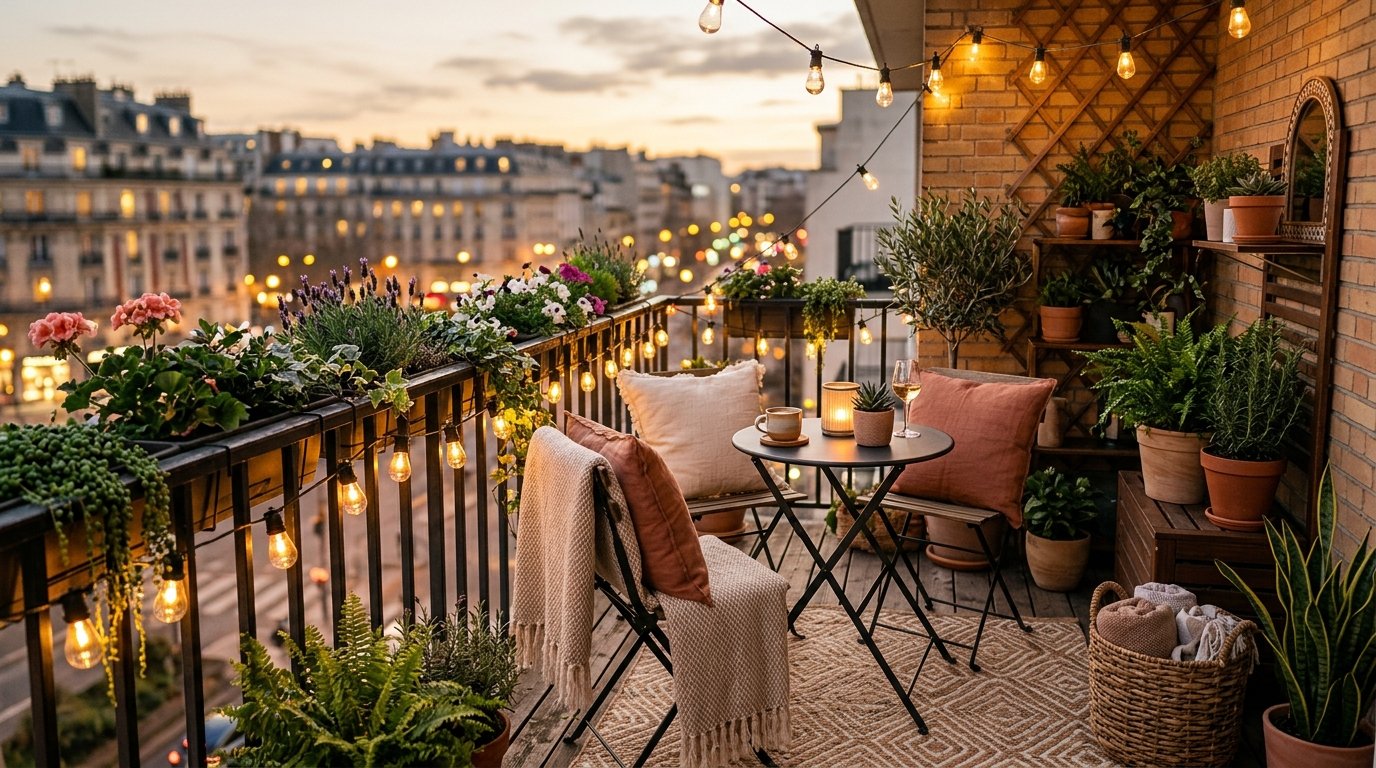
You’ve got a small balcony. Maybe it’s six feet by eight. Maybe it faces a parking lot. Maybe right now it holds a forgotten potted plant, a chair you moved out there once, and a lot of unrealized potential. That’s not a small balcony — that’s an unfinished room.
The thing about small outdoor spaces is that most advice is written for people who don’t actually have small spaces. The ‘balcony’ in the magazine has a panoramic view and room for a sectional sofa. Yours has a railing and about as much square footage as a walk-in closet. And yet, with the right ideas, a small balcony can feel like the best spot in your home — a place to have morning coffee in peace, read a book in the afternoon, or share a bottle of wine at dusk.
Below, you’ll find 28 concrete, doable ideas — from $10 quick wins to considered investment pieces — covering seating, lighting, plants, privacy, flooring, and ambience. Every idea was chosen with one question in mind: does this actually work on a small balcony? If it requires a yard or a power drill or a homeowner’s permission slip, it’s not here.
Before you scroll: if you only do one thing from this list, do #2 (string lights) or #3 (an outdoor rug). Together, they cost under $60 and they will make your balcony feel finished overnight.
1. A Bistro Table and Two Chairs
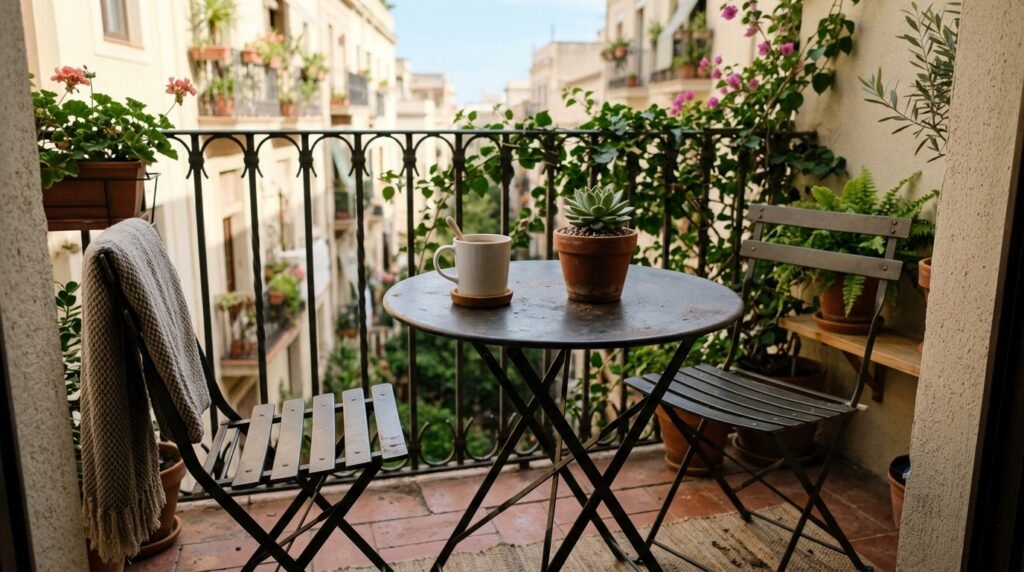
What it is: A small round table — usually 24 to 28 inches in diameter — paired with two lightweight metal or rattan chairs. It’s the classic European café setup, and it fits almost every small balcony.
Why it works: A bistro set gives your balcony a clear identity. It says ‘this is a place where things happen.’ Even if you use it just for morning coffee, it transforms the space from a storage ledge into a destination.
How to get it: Look for folding bistro sets if space is very tight — they press flat against the wall when not in use. Cast iron is beautiful but heavy; powder-coated steel or aluminum is lighter and just as durable. Rattan-effect resin weathers better than natural rattan.
Best materials: Powder-coated steel, aluminum, or resin wicker. For cushions, look for Sunbrella or polyester fill rated for outdoor use.
Pro tip: Size the table to the space, not the fantasy. A 24-inch table is enough for two mugs, two plates, and a plant. Anything bigger on a small balcony starts to feel like furniture shopping gone wrong.
Cost: $80–$250 for a full set. IKEA’s TÄRNÖ set is a reliable budget option; Threshold at Target offers mid-range quality.
2. String Lights Along the Railing or Ceiling
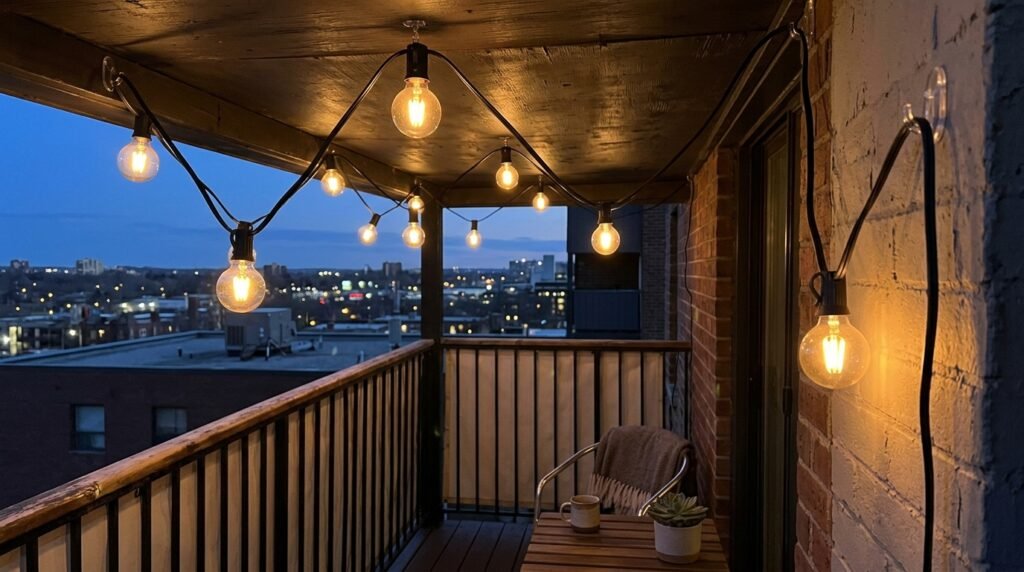
What it is: Outdoor-rated Edison-style string lights hung along your railing, overhead, or zigzagged across the balcony. They are, without question, the single highest-impact thing you can add to a small outdoor space.
Why it works: String lights change the quality of light from overhead and harsh to warm and diffused. They make an evening on a small balcony feel intentional — like you’re somewhere, not just sitting outside by default.
How to get it: Use outdoor-rated lights (IP44 or higher). For renters, adhesive hooks rated for outdoor use — 3M Command strips with outdoor adhesive — work on most surfaces without damaging the wall. Run them along the underside of the ceiling if you have one above, or clip them to the railing and overhead with zip ties.
Best options: G40 or S14 Edison bulbs for warm ambiance; solar-powered strings for renters who don’t have outdoor outlets.
Pro tip: Warm white (2700K–3000K) feels cozy. Daylight-white feels like a construction site. Always go warm.
Cost: $15–$60 for a quality set. Solar options cost a little more but eliminate the cord problem.
3. An Outdoor Rug to Ground the Space
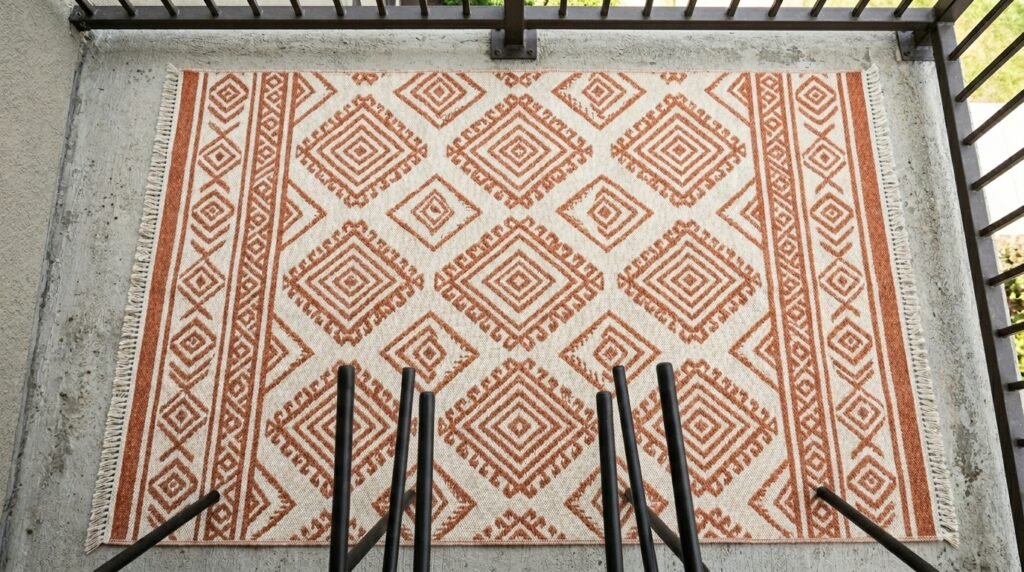
What it is: A weather-resistant rug laid directly on your balcony floor — typically made from polypropylene, jute-look synthetic, or recycled plastic weave.
Why it works: Nothing makes a balcony look more like a room than a rug. It visually defines the seating area, softens the concrete or tile underfoot, and adds color and texture where there was only grey.
How to get it: Measure your balcony and size the rug so it fits under the front legs of any furniture you’re using. An 4×6 or 5×7 works for most small balconies. Look for flat-weave styles — they drain quickly after rain and don’t trap mildew the way tufted rugs do.
Best options: Polypropylene is the most durable and easiest to hose down. Check Ruggable, Wayfair, or Amazon for outdoor-specific options. Moroccan diamonds and simple stripes tend to look best in small spaces.
Pro tip: Anchor the rug with furniture legs so wind doesn’t lift it. On very exposed balconies, consider rug tape or peel-and-stick grippers on the underside.
Cost: $30–$120 depending on size. You can find excellent options in the $40–$70 range.
4. Railing Planter Boxes
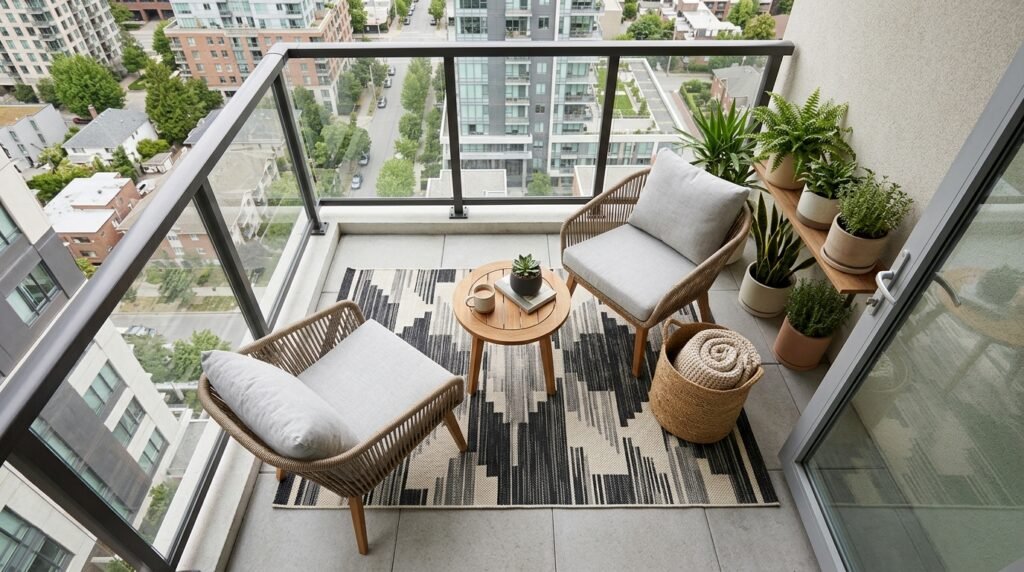
What it is: Planters designed to clip or hook directly onto your balcony railing, hanging either inside (facing you) or outside (facing out). They take up zero floor space.
Why it works: Railing planters add greenery at eye level — which feels lush and alive — without sacrificing even an inch of floor area. On a small balcony, that’s a meaningful trade.
How to get it: Make sure the planter is sized for your railing width — most fit railings between 1.5 and 4 inches. Self-watering railing planters are worth the extra few dollars; they have a reservoir that reduces how often you need to water and prevents soil from draining onto a neighbor below.
Best plants: For sun-facing balconies: petunias, marigolds, basil, thyme. For shade: impatiens, ferns, or trailing ivy. For a mix: calibrachoa spills over the edge beautifully.
Pro tip: Group two or three planters together on the same rail section rather than spacing them out evenly — it looks more intentional and less like a DIY experiment.
Cost: $12–$35 per planter. Lechuza makes premium self-watering versions; Bloem makes reliable budget options.
5. A Folding or Stackable Chair Set
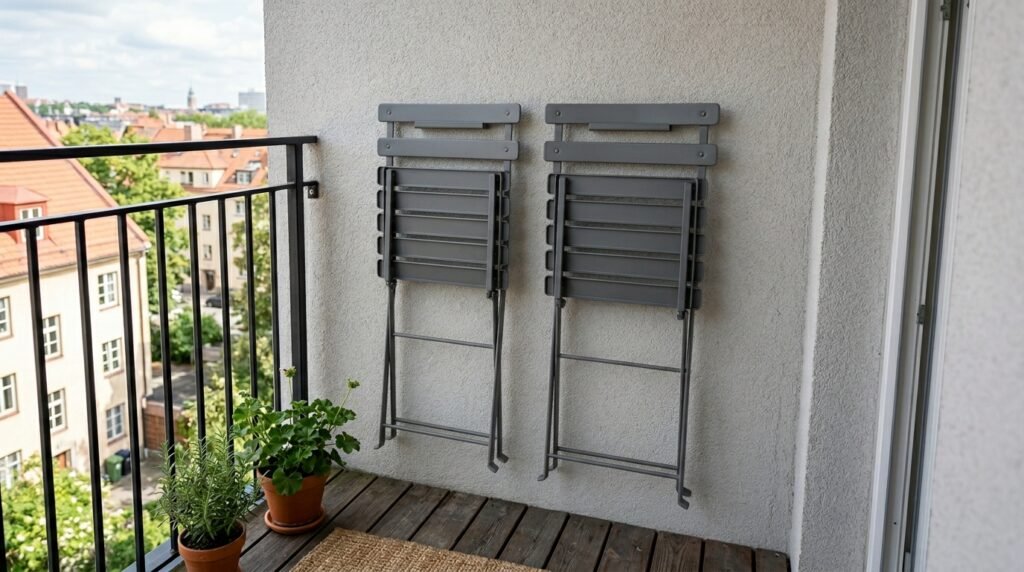
What it is: Chairs that fold completely flat or stack tightly so they can be moved inside or stored against a wall when not in use.
Why it works: On a small balcony, multi-use and storable furniture dramatically increases what the space can do. Two folding chairs take up almost no room when not in use, which means you can leave the floor open for other activities or expand seating when guests come.
How to get it: Folding metal chairs (bistro-style) lean flat against a wall. Stackable Tolix-style chairs are heavier but virtually indestructible. Look for chairs that also fold at the seat, not just the legs, for true slim storage.
Best options: The Fermob Luxembourg chair is the gold standard (and the price). For budget, Target’s folding metal café chairs are a solid alternative at around $30 each.
Pro tip: Get a wall-mounted hook or a thin over-the-railing hook to hang folded chairs vertically — that’s the most efficient storage method for a small balcony.
Cost: $25–$120 per chair.
6. Hanging Egg Chair or Hammock Chair
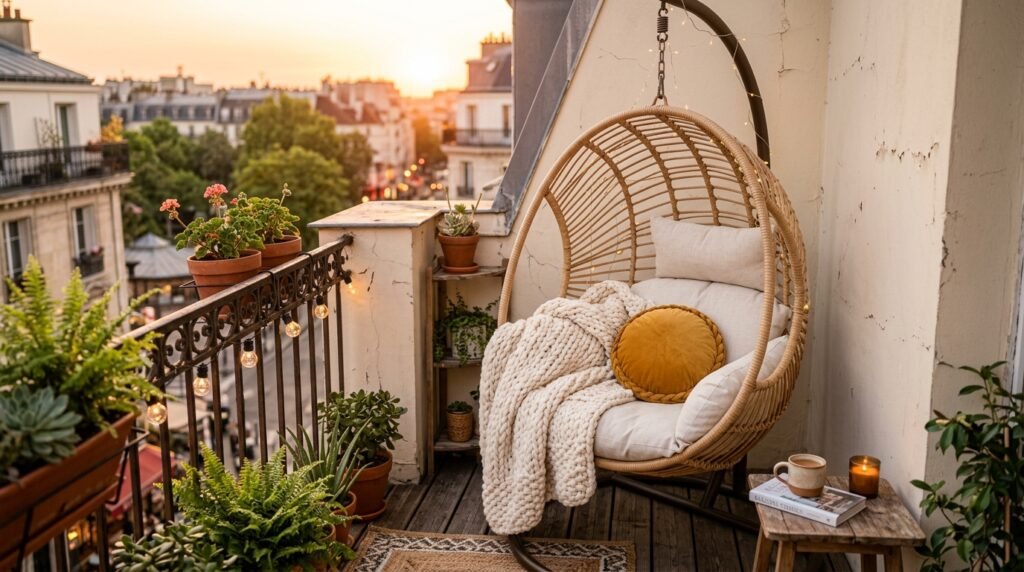
What it is: A rounded chair that hangs from a ceiling hook or a freestanding frame, designed for lounging rather than upright sitting.
Why it works: A hanging chair does what no other single piece of furniture does — it makes a small balcony feel like an experience. It’s a destination in itself. It also floats above the floor, which makes the space feel less crowded than a sofa or armchair would.
How to get it: For renters, a freestanding hanging egg chair frame is the easiest option — no drilling, no ceiling attachment. Check that your balcony floor can support the weight (most balconies are rated for 40–60 lbs per square foot, so a 25 lb frame plus an adult is fine). For those who can drill, a ceiling-mounted hook rated for 300+ lbs gives a cleaner look.
Best options: The hanging egg chairs from IKEA (HÄNGIG) or Sunnydaze are good entry-level options. For something more durable, Boho Hammocks and Christopher Knight are well-reviewed.
Pro tip: Add an outdoor throw pillow and a small blanket inside the chair. It transforms from ‘interesting seat’ to ‘my favorite place in the house.’
Cost: $80–$400 for freestanding options. Ceiling-hung chairs with the hardware run $60–$200.
7. Solar-Powered Lanterns
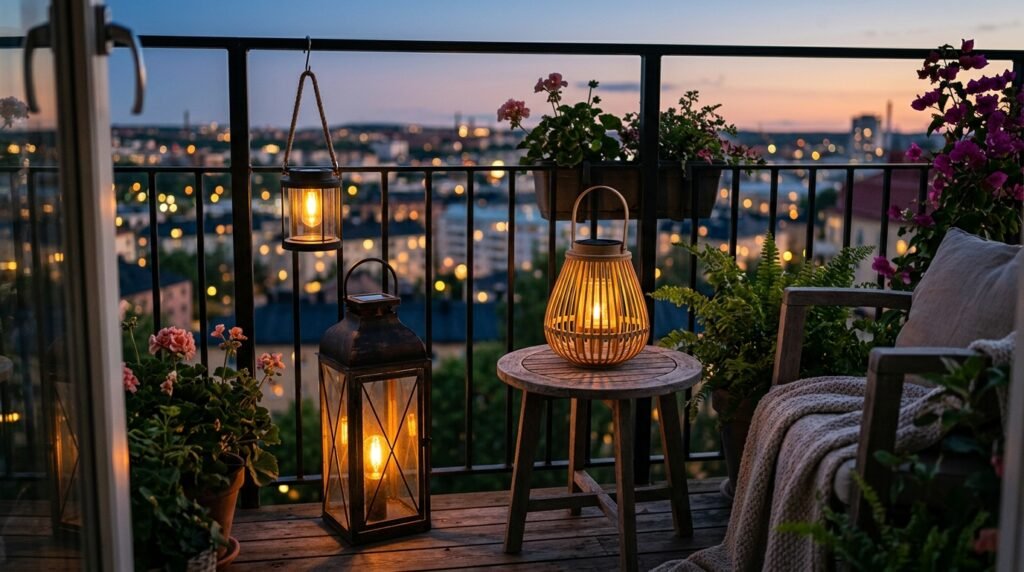
What it is: Decorative lanterns — hanging, tabletop, or floor-standing — that charge via a small solar panel during the day and glow at night.
Why it works: Solar lanterns solve the no-outlet problem completely. They add ambient light in multiple spots without any cord management, and they turn on automatically at dusk so your balcony looks beautiful even when you forget.
How to get it: Look for lanterns with a warm LED (not cool blue) and a solar panel rated for at least 8 hours of light output. Hanging lanterns are great from a ceiling hook; tabletop lanterns work on a side table or railing shelf. Cluster three different heights for the best effect.
Best options: Hampton Bay and Brightech make reliable outdoor solar lanterns. Avoid ultra-cheap ones — the solar panels degrade quickly and the light output is rarely as described.
Pro tip: Place the solar panel where it gets the most direct sun during the day, even if that means the lantern body hangs slightly in shade. The panel doesn’t need to be attached to the decorative part on all models.
Cost: $15–$60 per lantern.
8. Outdoor Throw Pillows and a Weather-Resistant Blanket
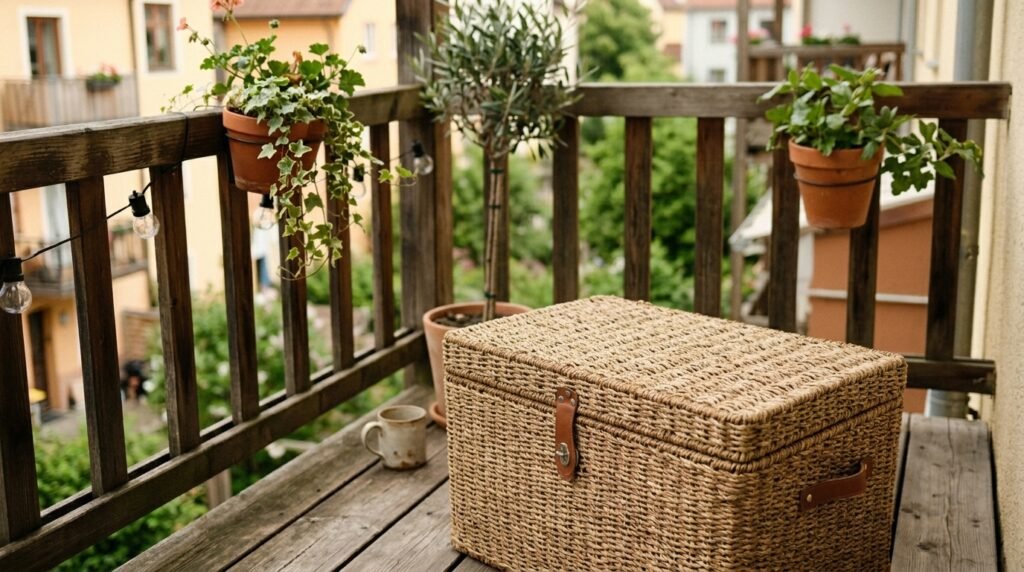
What it is: Pillows filled with quick-dry polyester fill, covered in fade-resistant outdoor fabric, plus a chunky knit or fleece throw blanket kept in a basket.
Why it works: Pillows and blankets are what make the difference between ‘sitting outside’ and ‘relaxing outside.’ They signal comfort. They also let you use the balcony in cooler weather — which, depending on where you live, triples your outdoor season.
How to get it: Look for pillows labeled ‘outdoor’ with Solution-Dyed Acrylic or Sunbrella fabric — these don’t fade in sun the way indoor pillows do. For blankets, waffle-knit cotton or fleece works better than wool (which can mat when damp).
Best colors: Dusty terracotta, warm sage, cream, and rust tend to feel cozy outdoors rather than clinical. Avoid cold blues and greys unless your space has warm wood tones to balance them.
Pro tip: Keep the blanket in a sealed bin or basket when not in use — it prevents that musty outdoor smell from developing over a rainy week.
Cost: $12–$40 per pillow; $20–$60 for a blanket. IKEA and H&M Home are reliable budget options.
9. Snap-Together Wood or Stone Deck Tiles
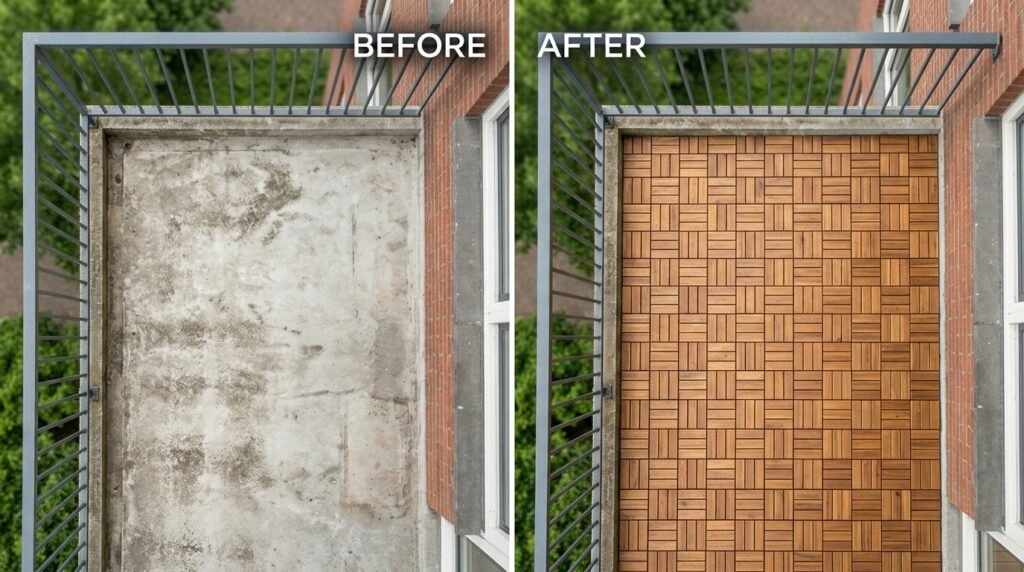
What it is: Interlocking floor tiles — usually acacia wood slats or slate-look stone — that click together like puzzle pieces directly over existing concrete or tile. No adhesive, no tools, fully removable.
Why it works: Bare concrete reads as unfinished. Deck tiles make a balcony feel like a designed space. The texture underfoot and the warmth of wood or stone changes the entire atmosphere of the area.
How to get it: Measure your balcony and buy tiles to cover the area. Most come in 12×12 inch squares. You can cut them with a jigsaw for edges. Acacia is the most popular material — beautiful, durable, and naturally weather-resistant. Leave a slight gap along walls to allow drainage.
Best options: IKEA RUNNEN (affordable, widely available), Cali Bamboo, or Amazon basics deck tiles. For a stone look, try porcelain or slate-style composite tiles.
Pro tip: Lift the tiles once a year and check the concrete below for moisture issues. Let the tiles air-dry when you do.
Cost: $1.50–$5 per tile (12×12 inch). A 60 sq ft balcony would cost $70–$300 depending on material.
10. Vertical Garden Wall Panel
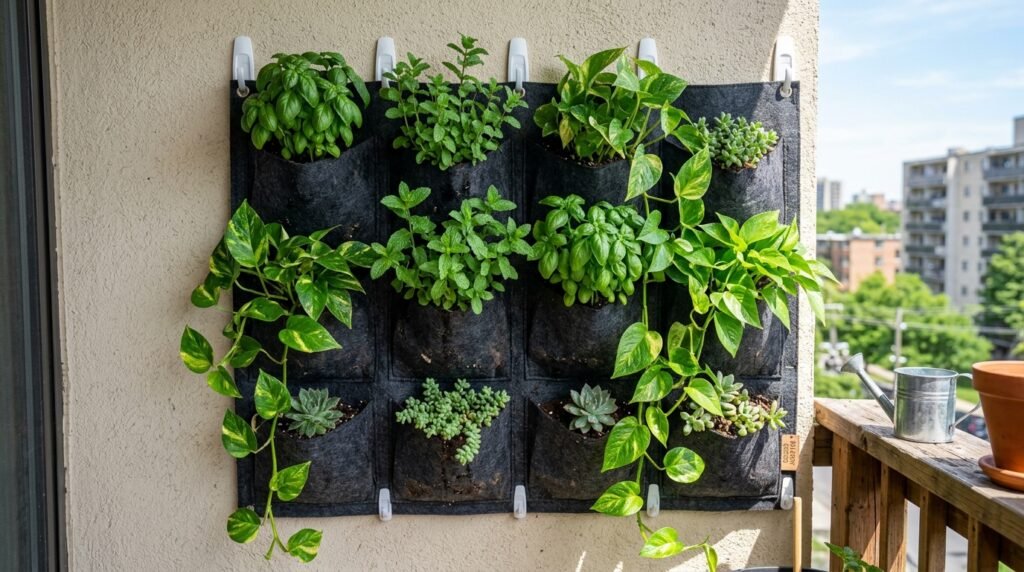
What it is: A modular panel system mounted on a wall or hung from the railing that holds multiple small planters vertically — turning a blank wall into a living green installation.
Why it works: When floor space is limited, the walls become your planting area. A vertical garden can hold 12–20 plants in the same footprint as one large floor planter. It also creates a living focal point that looks incredible.
How to get it: Look for wall-mounted pocket planners in felt (lightweight, breathable) or modular plastic clip systems. Most can be hung without drilling using heavy-duty Command hooks. Make sure you’re planting into pockets with drainage — sealed pockets lead to root rot.
Best plants: Herbs (basil, mint, chives, parsley), succulents, trailing pothos, ferns, strawberries. Match sun requirements to your balcony’s exposure.
Pro tip: Water vertical gardens more frequently than floor planters — smaller soil volumes dry out fast, especially in sun. A watering schedule twice a week in summer is typical.
Cost: $25–$100 for the panel system. Soil and plants are additional.
READ HERE: 29 Small Apartment Living Room Ideas That Make Any Space Feel Bigger
11. Privacy Screen or Bamboo Fence Panel
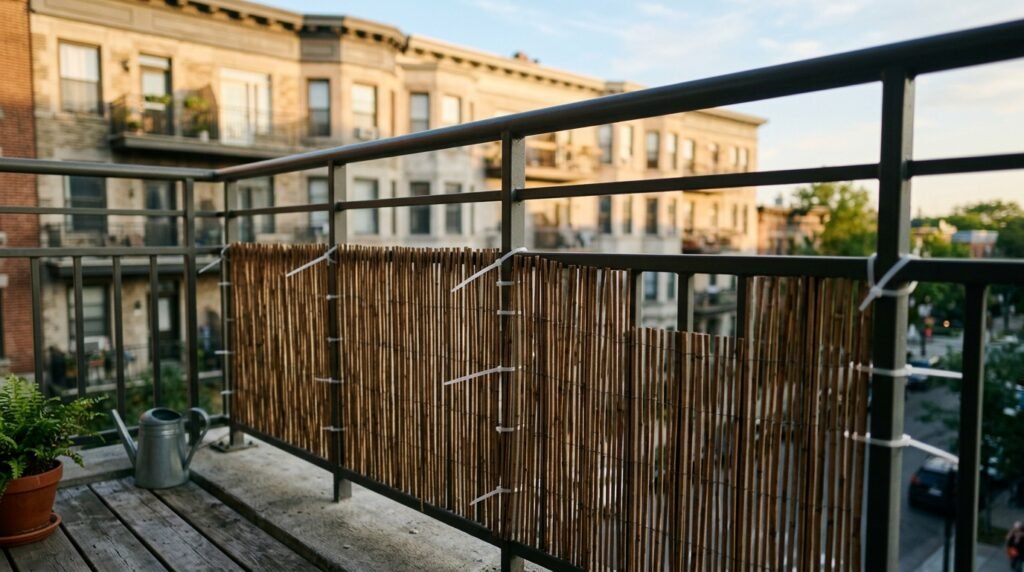
What it is: A freestanding or railing-mounted panel — in bamboo, reed, wood slat, or metal — that creates a visual barrier between your balcony and neighboring units or a busy street view.
Why it works: Privacy makes a space feel like yours. A balcony with no separation from your neighbors never quite relaxes you. Even a partial screen changes how comfortable the space feels to actually sit in.
How to get it: Bamboo reed fencing rolls are the most budget-friendly — tie them to the railing with zip ties or wire. Wood slat panels look more polished and can be mounted in a frame for easy removal. Metal laser-cut privacy panels add a modern touch. For renters, avoid any permanent installation — secure to the railing only.
Best options: IKEA RUNNEN fence panels, bamboo roll fencing from any garden center, or pre-made lattice panels. For more permanence, cedar or redwood slat panels weather beautifully.
Pro tip: A privacy screen doesn’t need to be opaque to work. A slatted or lattice design still blocks sightlines while allowing airflow — important on a small balcony where a solid screen can create a windtunnel or feel claustrophobic.
Cost: $15–$80 depending on material and size.
12. Weather-Resistant Curtains
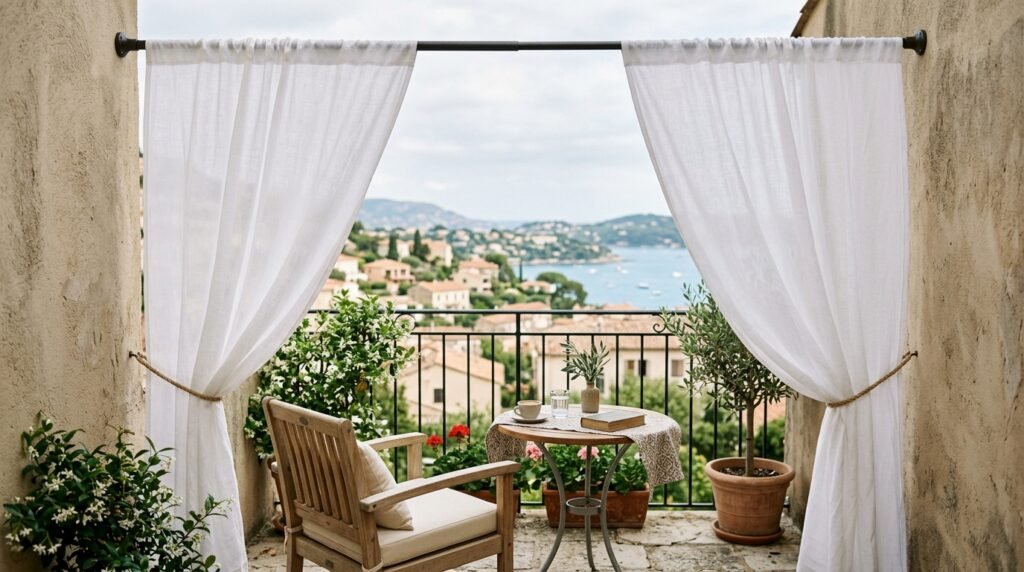
What it is: Curtain panels made from outdoor-rated fabric (polyester or Sunbrella) hung from a tension rod, ceiling rod, or curtain wire to create soft walls around the balcony.
Why it works: Curtains do three things simultaneously: they provide privacy, block wind when pulled closed, and make the space feel like an outdoor room rather than an exposed ledge. They also soften the look of the entire space dramatically.
How to get it: Use a tension rod between two walls if you have them, or mount a curtain rod using outdoor adhesive hooks. Outdoor curtain panels are available at most home retailers. White or linen-toned panels reflect heat and feel airy; darker colors create a more dramatic, cocoon-like effect.
Best options: IKEA HJÄRTELIG outdoor curtains, H&M Home outdoor panels, or any polyester panel marked ‘outdoor-safe.’ Grommet-top styles are easiest to hang and slide.
Pro tip: Tie the curtains back during windy weather — loose outdoor curtains in a high wind make a lot of noise and can tangle around furniture. Use curtain tieback hooks or simple rope ties.
Cost: $20–$60 per panel pair.
13. A Canopy or Shade Sail
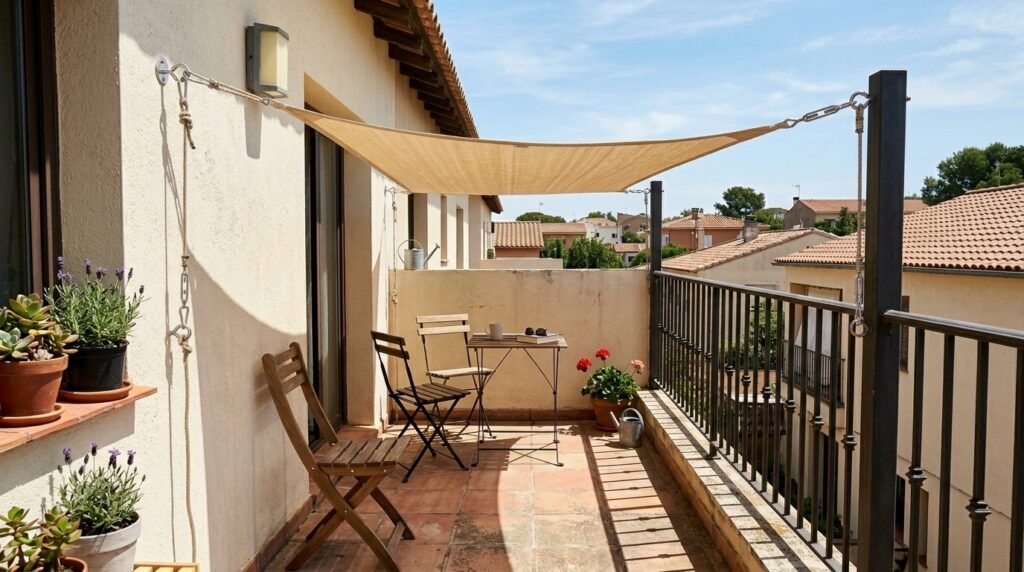
What it is: A fabric canopy — either a retractable awning, a fixed mounted canopy, or a freestanding triangle sail — that creates shade overhead on a sunny balcony.
Why it works: A south or west-facing balcony is often unusable in summer afternoon heat. Shade is the single most impactful functional upgrade you can make to an overexposed balcony. It also creates a sense of shelter that makes the space feel more intimate.
How to get it: For renters, a freestanding canopy with four legs is the simplest approach — no drilling. Shade sails can be attached to the wall, ceiling, or railing posts with eye hooks. Retractable awnings require more permanent installation but are the most versatile.
Best materials: HDPE shade cloth (90% UV blockage) for maximum sun protection while still allowing air through. Canvas for a more traditional awning look.
Pro tip: Orient a shade sail so it angles slightly — not perfectly flat — which allows rainwater to run off rather than pool in the center. A 10–15 degree angle is enough.
Cost: $30–$100 for a shade sail; $80–$300 for a freestanding canopy.
14. Floor Cushions or an Ottoman Pouf
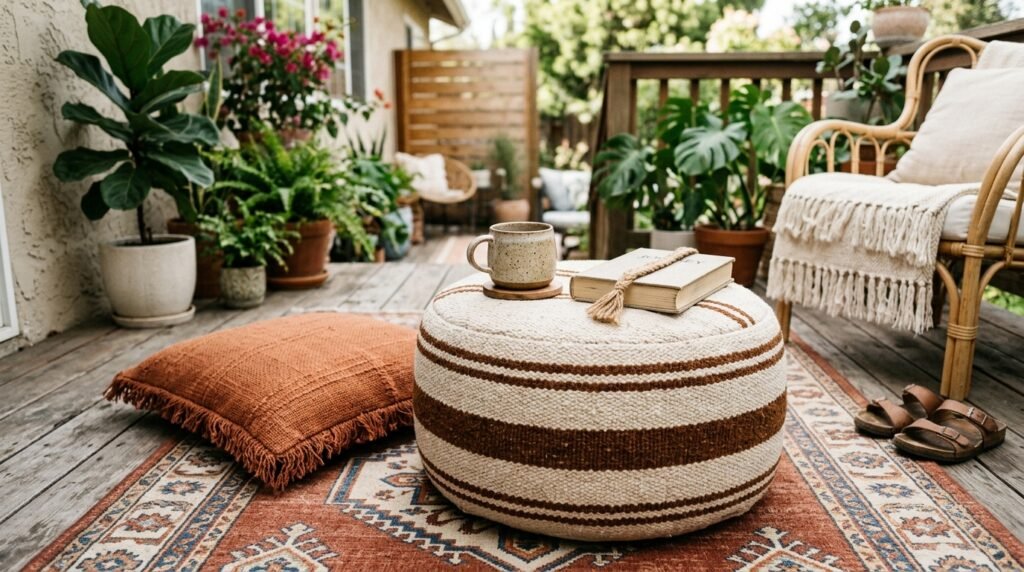
What it is: Large, floor-level seating — either a flat cushion, a tufted pouf, or a stuffed ottoman — that provides flexible seating without the footprint of a chair.
Why it works: Floor cushions or a pouf can be picked up and moved anywhere in seconds. They serve as extra seating when a guest arrives, a footrest when you’re alone, and a surface for a tray or a candle when no one is sitting. On a small balcony, that kind of flexibility is worth a lot.
How to get it: Look for outdoor-rated poufs filled with polystyrene beads (like a Moroccan pouf or a bean bag style). Flat floor cushions should have a waterproof insert or cover. Store both inside if you live somewhere with heavy rain.
Best options: The Fatboy Lamzac hanging pouf, Moroccan-style floor poufs from Overstock, or a simple round garden cushion from Target.
Pro tip: A round pouf or cushion looks better in a small space than a rectangular one — it doesn’t compete visually with the square lines of the floor, railing, and walls.
Cost: $25–$120 for a quality outdoor pouf.
15. A Wall-Mounted Folding Table
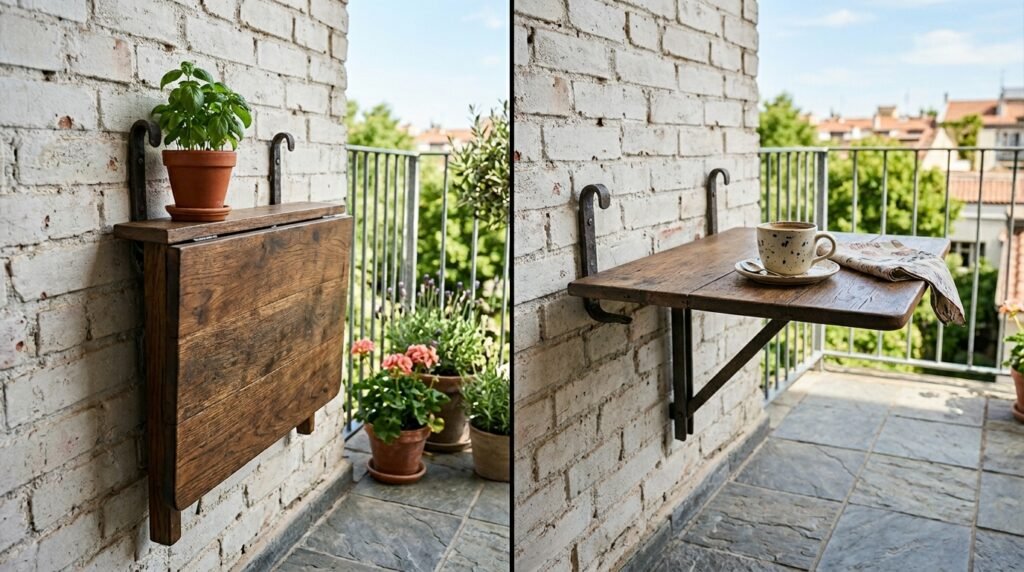
What it is: A table hinged directly to the wall that folds flat when not in use — essentially invisible when you don’t need it, fully functional when you do.
Why it works: A wall-mounted folding table is the ultimate space-saving move for a very small balcony. It gives you a surface for dining, working, or setting a drink without occupying any floor space when folded. It’s also one of the most useful things you can add if you want to use the balcony as a workspace.
How to get it: IKEA’s NORBERG wall-mounted drop-leaf table is the benchmark at under $25. Mount it at dining height (28–30 inches) or standing desk height (36 inches) depending on use. In a rental, confirm with your landlord before drilling — some apartments allow it, some don’t.
Best options: IKEA NORBERG, Murphy-style folding tables from Amazon, or any wall-mounted shelf bracket with a fold-down leaf.
Pro tip: Paint or stain the surface to match your other furniture so it looks intentional when open — and invest in two wall hooks to hold it perfectly flat when closed so it reads as a shelf, not a table.
Cost: $20–$80.
16. A Plant Ladder Shelf or Tiered Plant Stand
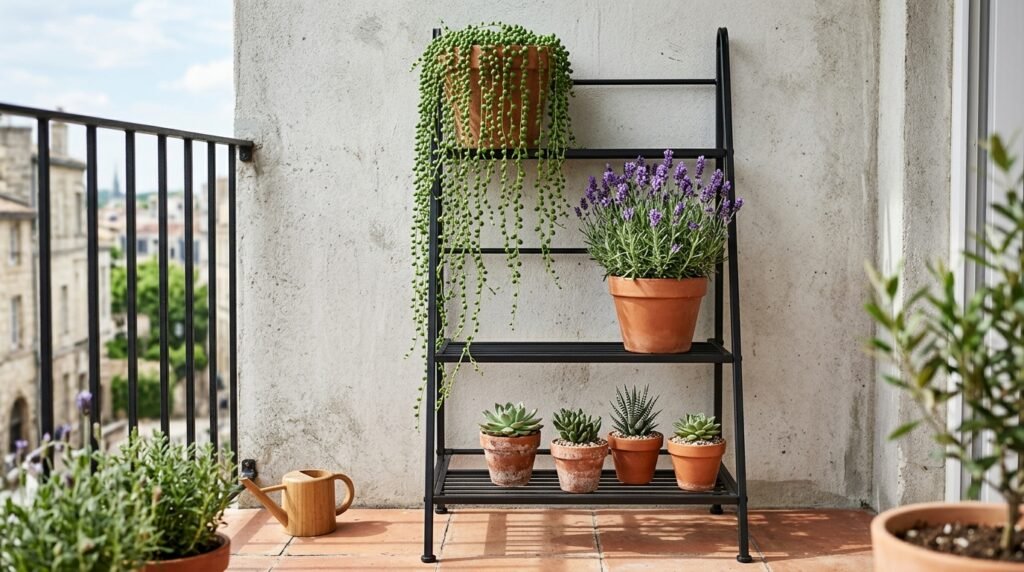
What it is: A freestanding ladder or stepped shelf designed to hold multiple plants at different heights — all within a footprint of about 12×18 inches.
Why it works: A plant ladder creates a vertical green display that feels abundant without taking up much floor space. It also gives you visual layering — plants at ankle, knee, and eye level — which makes the space feel lush and designed rather than like a few random pots.
How to get it: Look for outdoor-safe metal or treated wood ladders with at least three tiers. Space the plants so the lower ones don’t get completely blocked from light by the upper ones. Front-to-back staging — shorter plants in front, taller in back — solves this naturally.
Best plants: Mix textures and heights. Try a trailing string of pearls or sweet potato vine on the top rung, a compact lavender or rosemary in the middle, and low-growing succulents or herbs at the base.
Pro tip: Group plants with similar watering needs on the same shelf — that way you’re not overwatering drought-tolerant succulents because they’re next to thirsty ferns.
Cost: $25–$90 for the stand. Mid-range metal plant stands are widely available at Target, IKEA, and Amazon.
17. Tabletop Candles or Outdoor Lanterns
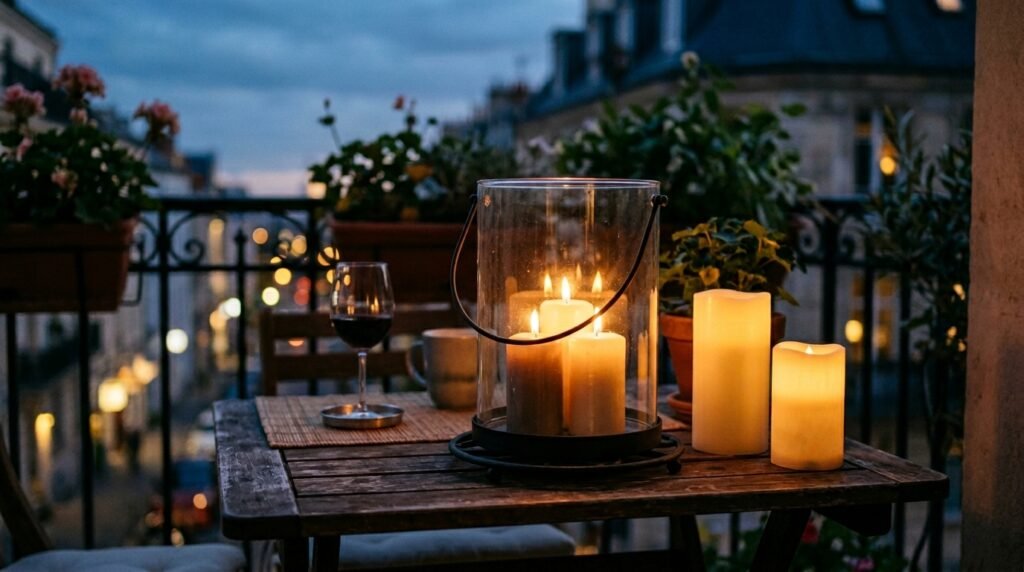
What it is: Candles — in glass hurricanes, metal lanterns, or ceramic vessels — placed on the table, railing shelf, or ground around the seating area.
Why it works: Candlelight is one of the few light sources that makes everyone look good and every space feel romantic. On a balcony, a few candles at golden hour creates an atmosphere that no overhead light can replicate. They’re also cheap, portable, and completely renter-friendly.
How to get it: Pillar candles in hurricane glass protect against wind. Flameless LED candles are safer on a windy balcony and last hundreds of hours. Citronella candles in warm weather have the bonus of deterring mosquitoes.
Best options: Luminara makes excellent flameless candles with realistic flickering. For real wax, beeswax or soy candles have a warmer, cleaner flame. Ikea’s SINNERLIG bamboo candle holder line is beautiful and affordable.
Pro tip: Never leave real candles unattended on a balcony, especially in dry or windy conditions. A flameless candle is almost indistinguishable from the real thing once it’s inside a glass lantern — and considerably safer.
Cost: $10–$50 depending on quantity and quality.
18. A Tabletop Fire Bowl or Small Fire Pit
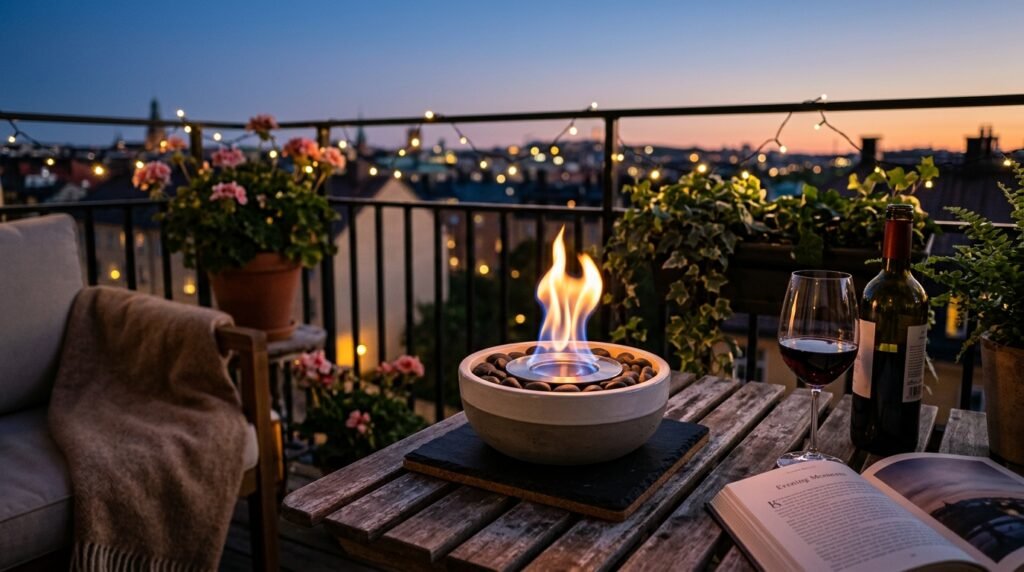
What it is: A compact fire feature — tabletop gel fuel burner, bioethanol tabletop fireplace, or a small propane fire bowl — designed for balcony use.
Why it works: Fire extends your balcony season into cool evenings and autumn nights. It’s also a natural focal point — a fire bowl on the table becomes the center of every evening gathering. It adds warmth (literal and atmospheric) that nothing else quite replicates.
How to get it: First, check your building or condo rules — some prohibit open flames on balconies entirely. If permitted, bioethanol or gel fuel fire bowls are the safest option: no gas lines, no sparks, controllable flame. Propane models are more powerful but require more care. Keep a lid or snuffer nearby.
Best options: Anywhere Fireplace for bioethanol tabletop models; Cuisinart and BALI OUTDOORS for propane fire bowls.
Pro tip: Set it on a heat-resistant trivet, never directly on a resin table. And always store fuel indoors — outdoor temperature fluctuations degrade bioethanol fuel over time.
Cost: $40–$200 for a quality tabletop fire feature.
19. An Herb Garden Container Cluster
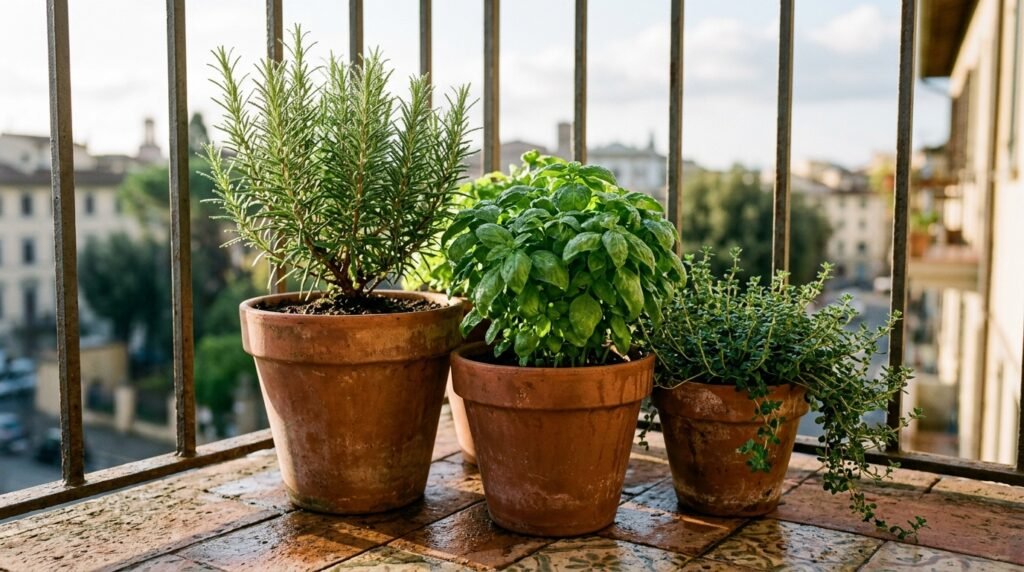
What it is: A grouping of three to five pots or containers growing culinary herbs — basil, rosemary, mint, thyme, chives, and parsley — arranged as a visual cluster on the floor or a shelf.
Why it works: Herbs do triple duty on a small balcony: they look good (especially when you mix textures and heights), they smell incredible (fresh basil in summer is its own sensory experience), and they’re actually useful — you’re growing something you’ll cook with. That makes the balcony feel productive, not just decorative.
How to get it: Plant herbs in their own individual pots rather than all in one container — they have different watering and root-space needs. Group them visually by clustering the pots together. Use terracotta for most herbs — it breathes, which helps prevent overwatering.
Best herbs for beginners: Basil (sun, regular water), mint (aggressive — keep it in its own pot or it takes over), chives (nearly indestructible), thyme and rosemary (drought-tolerant, low-maintenance).
Pro tip: Keep mint in its own sealed container, never in a shared planter — it will colonize every inch of soil if given the chance. Also, harvest frequently: cutting herbs regularly encourages bushier, more productive growth.
Cost: $5–$15 per plant/starter; terracotta pots are $3–$10 each.
20. A Compact Loveseat or Two-Seater Bench
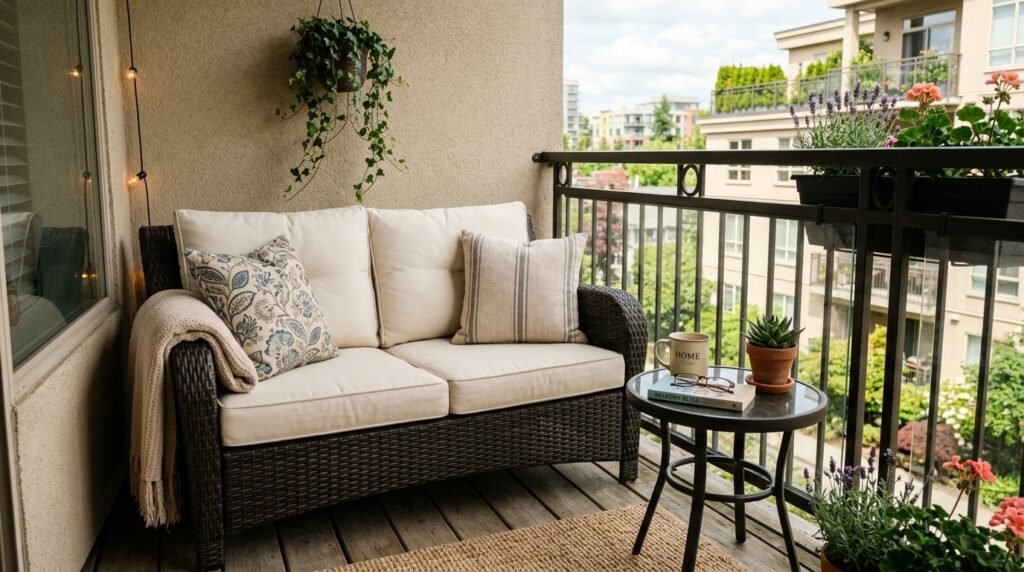
What it is: A small outdoor sofa or bench designed for two people — typically 42–52 inches wide — with cushions, made from rattan, metal, or acacia wood.
Why it works: A loveseat gives your balcony real ‘living room’ energy. You can lounge sideways, sit side-by-side with a partner, or curl up alone with your legs up. It’s a more relaxed seating option than chairs, and it makes the space feel genuinely comfortable — not just functional.
How to get it: Measure first — a 52-inch loveseat may not leave enough room for anything else on a 6-foot balcony. If space allows, pair it with a small side table and a coffee table pouf rather than chairs, which keeps the seating area cohesive. Rattan or resin wicker loveseats come with cushions and are the best value for small balconies.
Best options: Keter, Outsunny, and Christopher Knight all make well-reviewed compact outdoor loveseats under $300. For something more design-forward, CB2 and Article carry smaller-scaled options.
Pro tip: Get a loveseat cover for off-season storage — even outdoor furniture lasts significantly longer when not exposed to winter precipitation.
Cost: $150–$500.
21. Outdoor Wall Art or a Metal Wall Sculpture
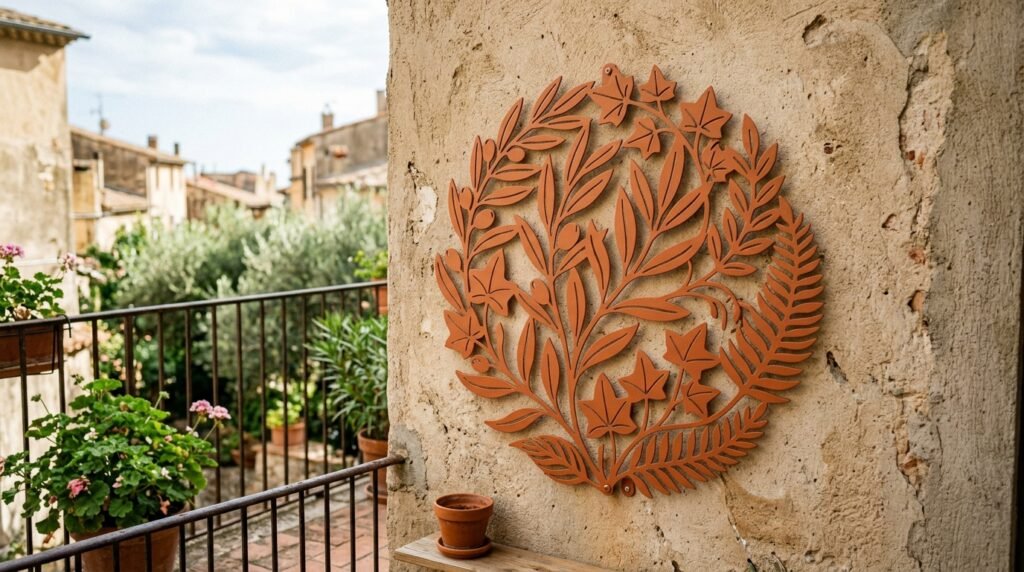
What it is: Decorative pieces designed for outdoor display — metal wall sculptures, ceramic tiles, driftwood arrangements, or weather-resistant prints — hung on the balcony wall.
Why it works: Bare concrete or stucco walls are the visual equivalent of a blank whiteboard. A piece of wall art — even something simple — makes the balcony feel curated and alive. It gives the eye somewhere to land other than the railing.
How to get it: Look for powder-coated metal wall art (stars, abstract shapes, botanical motifs) which can go directly outside. For framed prints, use a UV-resistant cover and hang under a protected area (like under a roof overhang) to extend their life. Removable outdoor adhesive strips work well for renters.
Best options: Wayfair and Etsy have excellent selections of outdoor metal wall art. Terracotta-colored metalwork looks particularly good against white or cream walls.
Pro tip: Scale matters more outdoors than indoors. A piece that looks substantial in a shop may get visually lost on a large wall. Go slightly bigger than you think you need.
Cost: $20–$150 depending on size and material.
22. A Compact Side Table with Hidden Storage
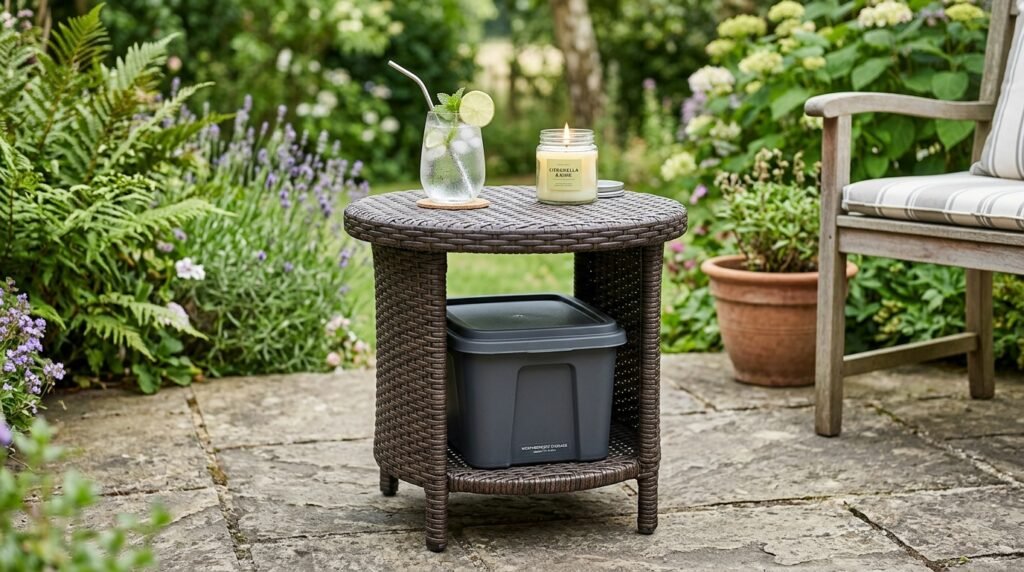
What it is: A small outdoor table — often round, 12–18 inches in diameter — that either has a built-in shelf below, a hollow interior for storage, or a lift-top that reveals a hidden compartment.
Why it works: Storage is the scarcest resource on a small balcony. A side table that holds a drink on top and sunscreen, a book, and a lighter on the shelf below earns its space twice over. It reduces the constant ‘bringing things in and out’ that makes small balconies feel high-maintenance.
How to get it: Look for rattan-effect resin cubes with an open bottom shelf, or a small metal side table with a wire basket underneath. Wooden cable drum tables (repurposed industrial spools) are another great option — they look beautiful and have a hollow interior.
Best options: The Target Threshold side table collection, Threshold (outdoor), or Amazon basics outdoor side tables with lower shelf.
Pro tip: Use a weatherproof bin or basket on the lower shelf — it keeps items organized and protected from rain without needing to run inside every time it drizzles.
Cost: $20–$80.
23. Privacy Planter Boxes with Tall Plants
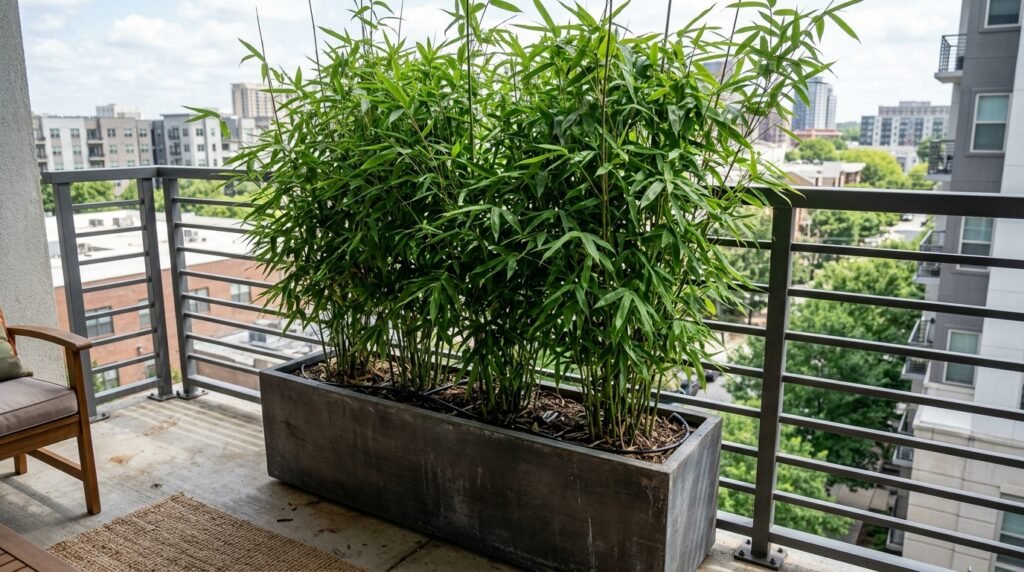
What it is: Deep floor planters — 18 to 36 inches tall — filled with upright, dense plants that create a natural green privacy screen along one side of the balcony.
Why it works: This idea solves privacy and greenery in a single move. Tall plants along the railing or along one side of a balcony block sightlines from neighboring units while making the space feel like a garden rather than an apartment attachment.
How to get it: Choose tall, narrow-growing plants that won’t outgrow the container too quickly. Tall planters filled with bamboo (clumping varieties, not running), ornamental grasses, or tall lavender work beautifully. Make sure planters have drainage holes and that drainage won’t flow onto a neighbor below — use saucers.
Best plants: Clumping bamboo (Fargesia species), tall ornamental grasses (Karl Foerster feather reed grass), columnar evergreens, or tall rosemary standards. For a flowering option, patio roses on a support stake.
Pro tip: Clumping bamboo is the key term. Running bamboo will escape the pot and cause problems. Always buy Fargesia or another clumping species when using bamboo in containers.
Cost: $30–$80 per planter; $15–$50 per plant.
24. A Railing Shelf or Balcony Bar Shelf
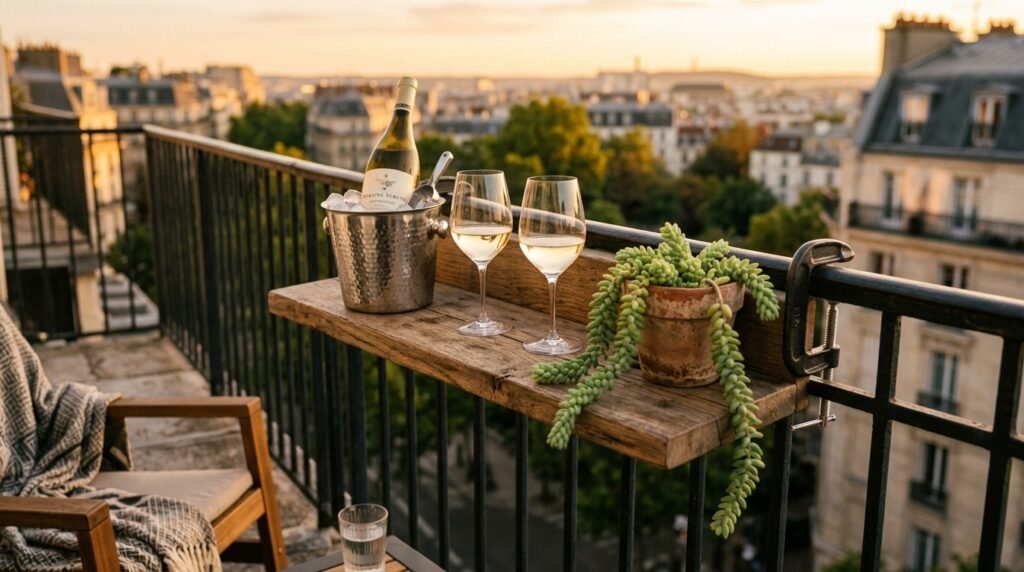
What it is: A narrow shelf — 6 to 10 inches deep — that clamps or hooks directly onto the top of your balcony railing, creating a ledge for drinks, plants, candles, or a small herb pot.
Why it works: The railing is wasted space on most balconies. A railing shelf turns it into a usable surface — giving you a bar area, a plant display spot, or simply somewhere to set a wine glass when you run out of table space. It adds function without touching the floor.
How to get it: Railing shelf hooks or clamps are widely available and rated for most standard railing widths. Make sure yours is secure and doesn’t wobble — a heavy plant pot on an unstable railing shelf is a falling object waiting to happen. Test the weight limit before loading it up.
Best options: Balcony Buddy, BalconyOrganizer, and Balcony Box all make well-designed railing shelves with solid hardware.
Pro tip: Use it as a bar setup for guests — a railing shelf with a small ice bucket, a few glasses, and a bottle of something makes a four-foot balcony feel like a proper outdoor entertaining space.
Cost: $20–$60.
25. An Outdoor Mirror
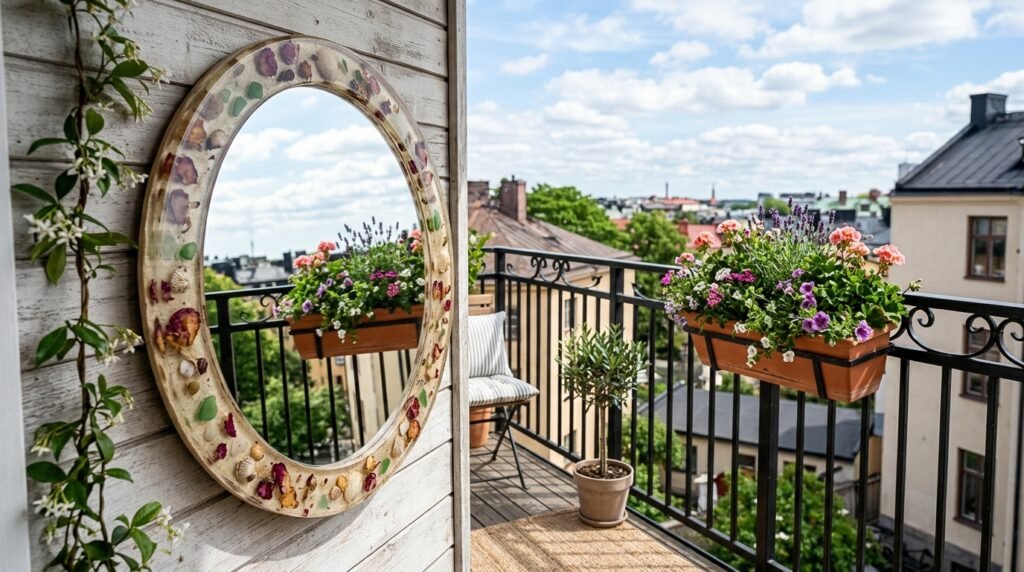
What it is: A weather-resistant mirror — framed in metal, rattan, or teak — mounted on the balcony wall.
Why it works: A mirror on a balcony does something visually remarkable: it doubles the apparent size of the space. When positioned to reflect the greenery, the sky, or the seating area, it makes a 50 sq ft balcony feel like 100 sq ft. It also reflects light into corners that might otherwise feel dim.
How to get it: Outdoor-specific mirrors use resin frames and shatterproof acrylic panels rather than real glass — safer if something falls. A full-glass mirror can be used under a protected overhang. Mount it securely using outdoor hardware — outdoor Command strips rated for 10+ lbs work for smaller mirrors in sheltered spots.
Best options: World Market, Wayfair, and Amazon all carry outdoor-rated mirrors in a range of styles. Round mirrors tend to look better on small balconies than large rectangular ones.
Pro tip: Angle the mirror slightly so it reflects the sky or greenery, not you sitting in your chair. You want the illusion of depth, not a constant reminder you’re on a small balcony.
Cost: $30–$150.
26. A Portable Bluetooth Speaker
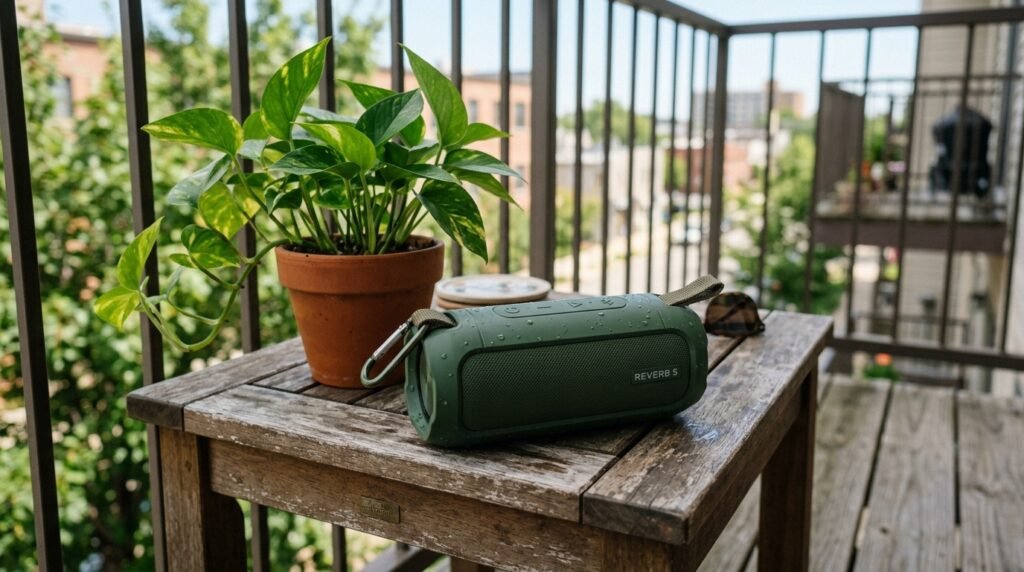
What it is: A compact, weatherproof (IPX5 or higher rated) Bluetooth speaker kept on the balcony for outdoor use.
Why it works: Music changes how you experience a space. A balcony that’s sonically alive — with ambient music, jazz, lo-fi beats, or whatever you love — feels twice as inviting as one in silence. A good portable speaker makes the whole outdoor experience feel complete.
How to get it: Look for an IPX7 waterproof rating (fully submersible — so a downpour won’t damage it) and at least 10–12 hours of battery life. Sound quality matters: look for a model with passive radiator or 360-degree sound if you’re setting it on a table where listeners are on multiple sides.
Best options: JBL Charge 5, UE Wonderboom 3, and Bose SoundLink Flex are the three best-reviewed outdoor portable speakers at their respective price points.
Pro tip: Set it to 50–60% volume on a balcony facing neighbors — outdoor sound carries much farther than indoor sound, and being a considerate neighbor is its own kind of lifestyle upgrade.
Cost: $40–$180.
27. A Mini Water Feature or Tabletop Fountain
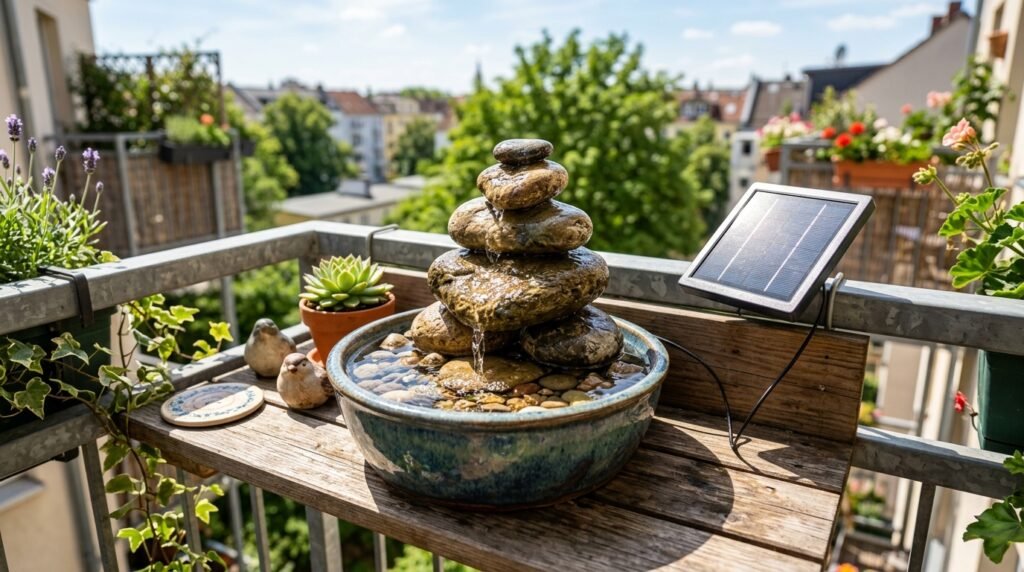
What it is: A small recirculating fountain — powered by a solar panel or a low-voltage plug — that creates the sound of moving water on your balcony.
Why it works: The sound of water is one of the most effective tools for creating a sense of calm. It also masks city noise — traffic, neighbors, street sounds — better than any other single addition to a small outdoor space. A tabletop fountain runs quietly, uses minimal electricity, and makes the balcony feel like an actual retreat.
How to get it: Solar-powered tabletop fountains need only direct sunlight and a bowl of water — no outlet required. Plug-in versions are more powerful and consistent. Look for a ceramic or cast-stone design — they look more natural than plastic and the weight prevents tipping in wind.
Best options: Alpine Corporation, John Timberland, and Sunnydaze all make quality tabletop fountains with good reviews for outdoor use.
Pro tip: Clean the pump every four to six weeks to prevent algae and mineral buildup, which will slow the water flow and shorten the pump’s life. A drop of white vinegar in the water helps keep it clear between cleans.
Cost: $30–$120 for a quality tabletop fountain.
28. A Styled Tray on the Side Table
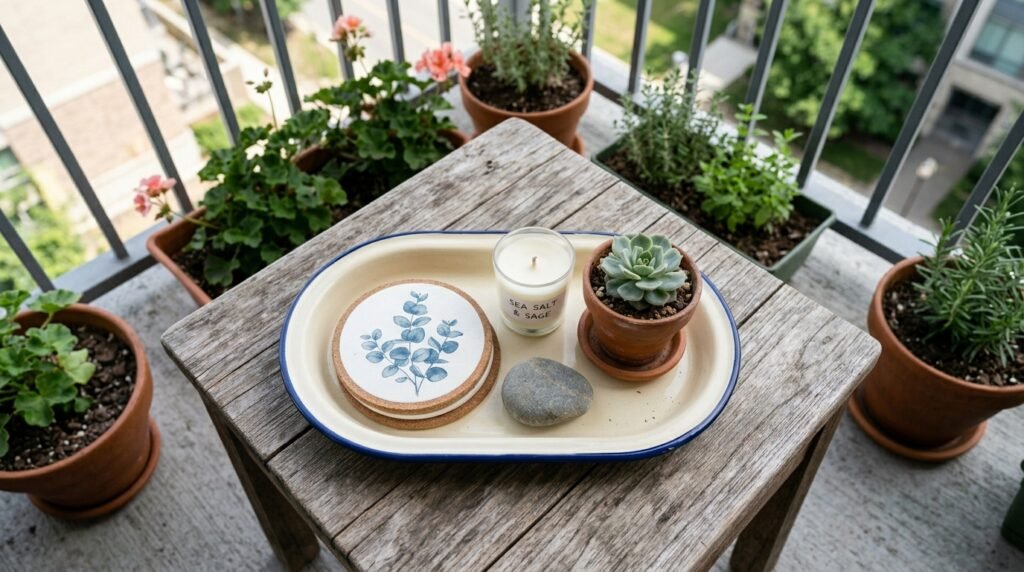
What it is: A weatherproof tray — ceramic, metal, or sealed wood — placed on your side table or railing shelf, styled with a few small objects: a candle, a small succulent, a coaster stack, a decorative stone.
Why it works: A tray is the design trick that makes random objects look intentional. It creates a visual boundary that says ‘these things belong together’ — which is the difference between a table that looks styled and one that just has stuff on it. It’s also the cheapest finishing touch on this list.
How to get it: Use any tray that can handle a little moisture — sealed wood, enamel, powder-coated metal, or ceramic. Style it with three to five small objects at different heights. Less is more: the tray should look curated, not cluttered.
Best options: Any metal or enamel tray from a kitchen or home store works outdoors. IKEA, H&M Home, and TJ Maxx all carry inexpensive trays in neutral tones.
Pro tip: Swap the tray objects seasonally — citronella candle and a sunscreen bottle in summer; pinecones and a small lantern in autumn. It takes two minutes and makes the balcony feel freshly decorated.
Cost: $8–$30 for the tray. Objects may be things you already own.
Where to Start
Twenty-eight ideas is a lot to take in at once — but you don’t need all of them. You need three or four that fit your space, your budget, and your life. A cozy outdoor retreat doesn’t require a perfect balcony or a designer’s eye. It requires a rug, a little light, something alive, and somewhere comfortable to sit.
If you’re starting from scratch, do this: string lights first, rug second, one or two railing planters third. That combination alone — under $100 and a single afternoon of work — will change how often you use the space. Everything else is an upgrade you can add as you go.
The best balcony is the one you actually spend time on. Start there.