
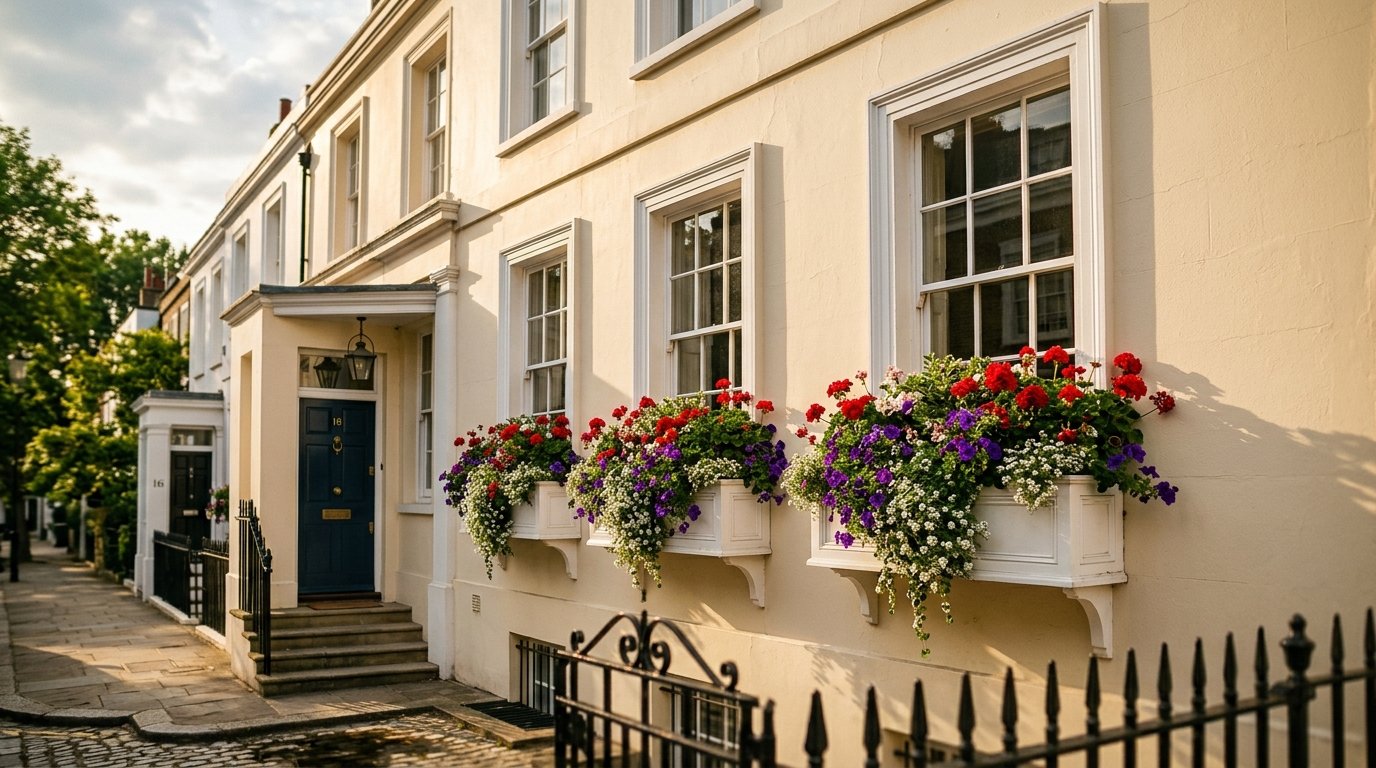
Nothing changes the face of a house faster than a well-planted window box — and most people are still leaving that power on the table.
You’ve probably driven past a home and thought, ‘That place looks so put-together.’ There’s a good chance a window box was part of the reason. Flowers at window height do something that ground-level landscaping can’t: they bring the garden up to eye level, frame the architecture, and make the whole front of the house feel intentional. It’s one of the most visible, highest-impact upgrades you can make to your home’s exterior — and it costs a fraction of what most curb appeal projects run.
In this guide, you’ll find 28 window box flower ideas for every house style, every sun exposure, every season, and every level of gardening ambition. Some are classics for a reason. Some are combinations you haven’t tried yet. All of them will make your windows look like they belong on a garden tour.
Before you scroll: If you want the single fastest upgrade, go straight to Idea #3 — the Thriller/Filler/Spiller formula. It’s the most reliable framework in window box gardening, and once you understand it, every window box you plant will look more intentional.
1. Classic Red Geraniums with White Alyssum
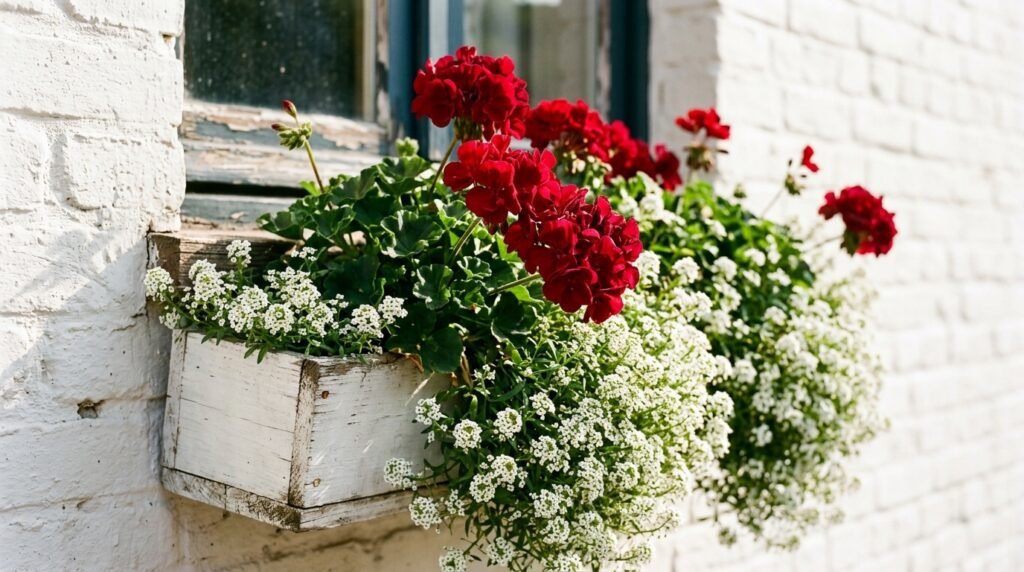
What it is: The combination that has earned its reputation over a century of front-porch gardening — upright red geraniums paired with sweet alyssum tumbling over the front of the box.
Why it works for curb appeal: Red reads from a long distance, which is exactly what you need from a window box. The white alyssum softens the look and provides movement as it spills. Against white, grey, or brick homes, this combination is genuinely hard to beat.
How to do it: Plant 3–5 upright geraniums (Pelargonium × hortorum) in the centre and rear of the box, then tuck sweet alyssum (Lobularia maritima) along the front edge. Space geraniums about 6 inches apart. Water when the top inch of soil feels dry.
Best varieties: ‘Rozanne’ red geraniums or ‘Orbit Red’ for reliability. ‘Snow Princess’ alyssum for the most vigorous trailing.
Pro tip: Deadhead your geraniums weekly. It takes 30 seconds and keeps them blooming all season instead of stopping mid-summer.
Cost/effort: $15–$30 for a standard 24-inch box. Low maintenance once established.
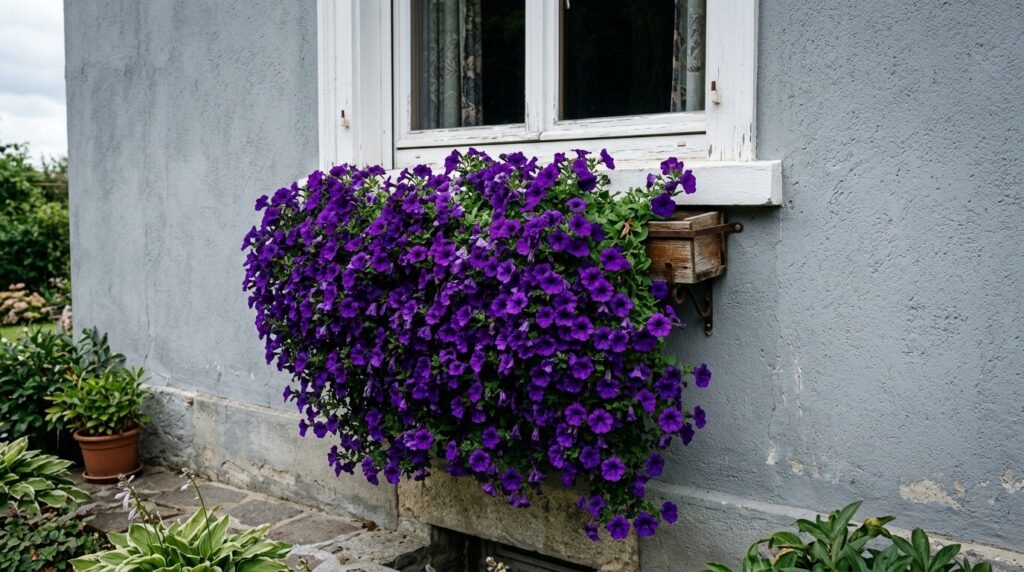
2. Trailing Petunia Cascade in a Single Colour
What it is: A window box planted exclusively with trailing Wave or Supertunia petunias in one bold colour — hot pink, deep purple, coral, or white — allowed to cascade freely down the front of the box.
Why it works for curb appeal: Monochromatic planting has a deliberateness that mixed colours sometimes lack. A solid wave of colour down the front of your house reads as confident and designed, not accidental.
How to do it: Plant one petunia every 8–10 inches in a row. Choose trailing varieties specifically — ‘Wave,’ ‘Easy Wave,’ or ‘Supertunia’ — not the upright mounding types. The trailing varieties will eventually hang 18–24 inches below the box, creating a dramatic waterfall effect.
Best varieties: ‘Wave Purple Classic’ for the deepest impact. ‘Supertunia Vista Bubblegum’ for a vibrant pink. ‘Easy Wave White’ for a clean, elegant look.
Pro tip: Feed trailing petunias every 10–14 days with a liquid bloom fertiliser — they’re heavy feeders, and without it they’ll thin out by July.
Cost/effort: $20–$35 for a 30-inch box. Low-moderate maintenance (fertilising is key).
3. The Thriller/Filler/Spiller Formula
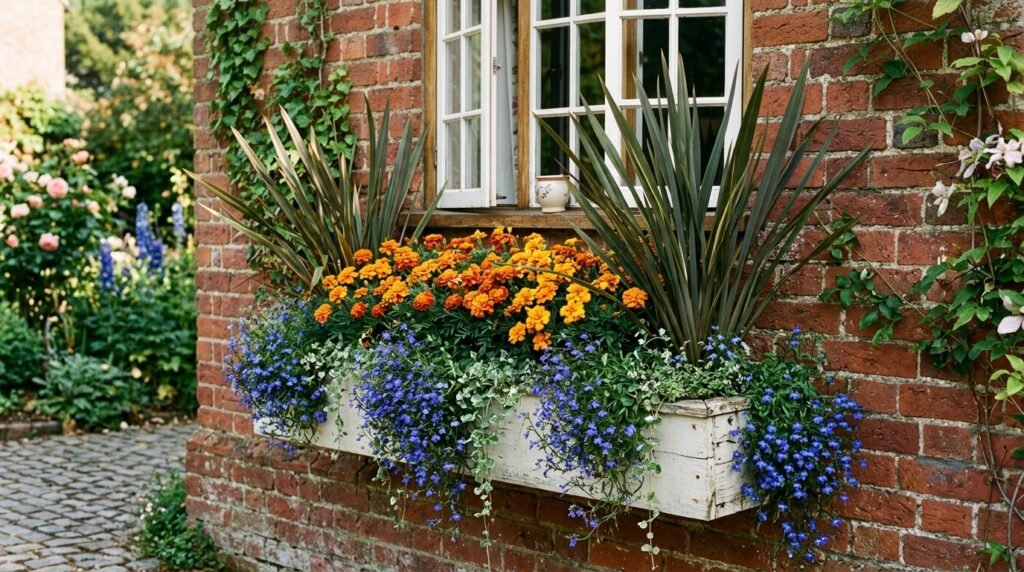
What it is: A three-part planting framework used by professional landscapers that gives every window box a balanced, full look — one tall ‘thriller’ plant in the back for height, dense ‘filler’ plants in the middle for body, and trailing ‘spiller’ plants in the front to cascade over the edge.
Why it works for curb appeal: This formula creates depth and layering that flat single-plant boxes simply can’t match. It also works with hundreds of different plant combinations, so you can adapt it to any house colour, season, or sun level.
How to do it: Choose one thriller (e.g., a tall grass, spike plant, or upright salvia), two or three fillers (compact petunias, marigolds, impatiens, or begonias), and one or two spillers (bacopa, lobelia, trailing verbena, or creeping jenny). Plant thriller at the back, fillers in the middle row, spillers along the front edge.
Best plant combos: Spike + coral impatiens + trailing lobelia for shade. Ornamental grass + orange marigold + creeping jenny for sun. Purple salvia + white alyssum + trailing verbena for a formal look.
Pro tip: The thriller should be at least 1.5–2× the height of your window box for the proportions to look right from the street.
Cost/effort: $25–$50 depending on plant choices. Moderate setup, low maintenance after.
4. Bi-Colour Lobelia and Bacopa
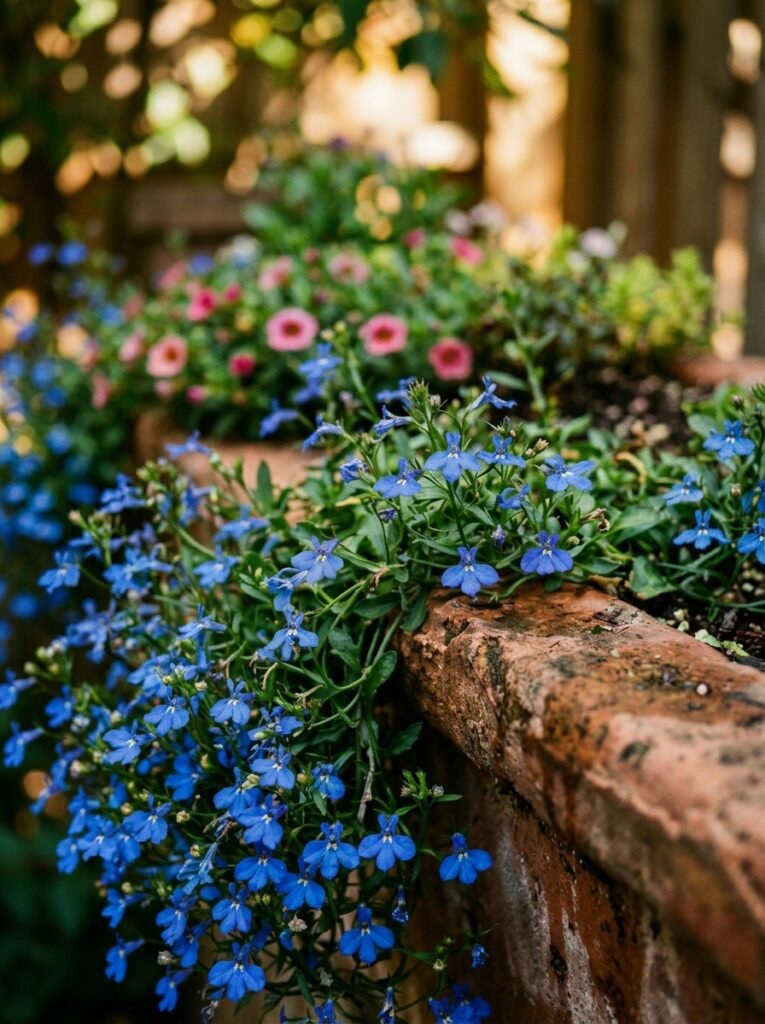
What it is: A soft, cottage-style combination of deep blue or violet lobelia and white bacopa — two trailing plants that weave together as they spill over the edge of the box.
Why it works for curb appeal: Blue is one of the rarest flower colours in the garden, which makes it immediately eye-catching. Paired with the delicate white stars of bacopa, this combination photographs beautifully and reads as charming from the street.
How to do it: Plant alternating lobelia and bacopa along the front of your box, with a taller filler (white impatiens or alyssum) behind. Both plants are cool-season performers, so this works brilliantly for spring and again in early autumn when temperatures drop.
Best varieties: ‘Crystal Palace’ lobelia for the deepest blue. ‘Snowflake’ or ‘Abunda White’ bacopa for reliable coverage.
Pro tip: Both lobelia and bacopa struggle in intense summer heat — if you’re in a hot climate, plant them in early spring, enjoy them through June, then swap to heat-tolerant annuals in July.
Cost/effort: $15–$25 for a 24-inch box. Low maintenance in cool weather.
5. Ornamental Kale and Autumn Mums
What it is: A fall-season window box built around the bold rosette shapes of ornamental kale or cabbage, paired with round-headed chrysanthemums in orange, burgundy, or gold.
Why it works for curb appeal: Most window boxes die after summer. A well-planted fall box keeps your windows looking intentional well into October and November, when the rest of the neighbourhood has given up.
How to do it: Plant a row of ornamental kale or cabbage (Brassica oleracea) toward the back, filling in around them with pot mums in complementary autumn colours. Add trailing variegated ivy if you want a spiller. These plants are frost-hardy, so don’t rush to pull them.
Best varieties: ‘Glamour Red’ or ‘Nagoya White’ ornamental kale. ‘Will’s Wonderful’ mums for best fall performance.
Pro tip: The colour on ornamental kale actually intensifies after a light frost — so let the cold come. The box will look better in late October than it did in September.
Cost/effort: $20–$40 for a fall replant. Low maintenance — mums need almost no deadheading.
📷 Image brief: A window box in early autumn with white ornamental kale rosettes and deep orange mums, with fallen leaves on the windowsill behind.
[Link opportunity: ‘ornamental kale’ → fall container planting guide]
6. Lavender and White: The French Farmhouse Look
What it is: A restrained, elegant window box planted with trailing lavender verbena or Scaevola (fan flower), white bacopa, and silver dusty miller — all together creating a soft, muted palette reminiscent of Provençal farmhouses.
Why it works for curb appeal: Lavender-and-white boxes look expensive without costing more. They also photograph exceptionally well against stone, white render, or grey weatherboard — and the soft colours don’t compete with the architecture the way hot pinks and reds can.
How to do it: Anchor the box with two or three ‘Imagination’ or ‘Homestead Purple’ trailing verbena for the lavender tones. Fill in with white bacopa or sweet alyssum. Add dusty miller (Senecio cineraria) as a silvery filler between them. All three tolerate heat and sun well.
Best varieties: ‘Imagination’ verbena for a true lavender tone. ‘Silver Dust’ dusty miller for the most striking silver contrast.
Pro tip: Dusty miller is drought-tolerant — don’t over-water it alongside the verbena or the roots will rot. Let the top two inches dry out before watering.
Cost/effort: $20–$35. Low maintenance, high-impact.
📷 Image brief: A narrow white-framed window with a lavender verbena and silver dusty miller box below it on a French farmhouse-style stone home.
[Link opportunity: ‘dusty miller’ → silver foliage plants for containers]
7. All-Foliage Box: Coleus, Caladium, and Creeping Jenny
What it is: A window box with no flowers at all — built entirely from bold, patterned foliage in contrasting shapes and colours: the flame-painted leaves of coleus, the heart-shaped splashes of caladium, and the bright chartreuse trailing tendrils of creeping jenny.
Why it works for curb appeal: Flowering boxes require regular deadheading to stay looking their best. A foliage box looks just as lush all season with almost no maintenance — and the colour range of modern coleus rivals anything that flowers.
How to do it: Choose coleus and caladium varieties with complementary colour patterns (both in the red-to-green spectrum, for example, or all burgundy-and-white). Plant caladiums at the rear for height, coleus in the middle for body, and creeping jenny along the front edge to trail.
Best varieties: ‘Chocolate Mint’ coleus for a dark, dramatic look. ‘White Queen’ caladium for a bold contrast. ‘Aurea’ creeping jenny for the brightest chartreuse spill.
Pro tip: Both coleus and caladium need partial shade — direct afternoon sun will scorch their leaves. A north or east-facing window is ideal.
Cost/effort: $25–$45. Very low maintenance — no deadheading required.
📷 Image brief: A lush all-foliage window box combining deep burgundy coleus, white caladium, and bright chartreuse creeping jenny on a shaded porch.
[Link opportunity: ‘caladium varieties’ → shade-loving container plants guide]
8. Dwarf Sunflowers and Trailing Nasturtiums
What it is: A cheerful, cottage-garden window box pairing compact dwarf sunflowers with the round-leafed trailing sprawl of nasturtiums in shades of orange, yellow, and red.
Why it works for curb appeal: This combination has genuine visual energy — sunflowers read as large and exuberant, nasturtiums as relaxed and overflowing. Together they look like a proper garden, not just a few plants in a box.
How to do it: Sow nasturtium seeds directly into the window box in mid-spring — they don’t transplant well but germinate easily from seed within 10 days. Plant dwarf sunflower seedlings (or start from seed at the same time) toward the rear. Both are fast-growing and will fill the box within 4–6 weeks.
Best varieties: ‘Sunspot’ or ‘Big Smile’ dwarf sunflowers — they max out at 12–18 inches, perfect for a box. ‘Jewel Mix’ nasturtiums for the widest range of warm tones.
Pro tip: Nasturtiums actually bloom more when the soil is slightly poor — resist the urge to fertilise them heavily, or you’ll get all leaves and no flowers.
Cost/effort: $5–$10 (mostly seed cost). Very low effort — both plants thrive on neglect.
📷 Image brief: A sunny window box with small yellow sunflower heads rising above a trailing mass of orange and red nasturtiums on a timber cottage exterior.
[Link opportunity: ‘nasturtium from seed’ → beginner container gardening guide]
9. Snapdragon Cascade for Early-Season Colour
What it is: A cool-season window box packed with trailing snapdragons (Antirrhinum) in bi-colour varieties — typically pink-and-white, apricot-and-cream, or purple-and-yellow — that hang over the edge in soft cascades.
Why it works for curb appeal: Snapdragons come into their own in spring and early autumn, giving you colour exactly when most of the neighbourhood’s boxes are bare. Their unique flower shape — the little ‘snap’ mouth — also looks different from the usual annuals, which gets noticed.
How to do it: Plant trailing snapdragon varieties (like the Luminaire or Twinny series) in a single-variety box or mix two complementary bi-colour types. They prefer cooler temperatures, so get them in early spring — they’ll hold colour well past first frosts.
Best varieties: ‘Twinny Peach’ for a soft apricot bicolour. ‘Candy Showers Rose’ for a trailing type with a strong blush-and-white look.
Pro tip: Pinch out the first few flower buds to encourage branching — a bushier plant means far more flowers through the season.
Cost/effort: $15–$25. Low maintenance. Replace with summer annuals when heat arrives.
📷 Image brief: A window box overflowing with apricot and cream trailing snapdragons in early spring, with a pale stone house wall behind.
10. Flowering Herb Box: Chives, Thyme, and Nasturtiums
What it is: A window box that doubles as a herb garden — using flowering herbs and edible flowers that are as visually attractive as ornamentals but useful in the kitchen too.
Why it works for curb appeal: Chives produce cheerful purple pompom flowers. Trailing thyme has tiny pink blooms. Nasturtiums are peppery and edible. Together they create a busy, cottage-garden texture that looks intentional from the street.
How to do it: Plant upright chives at the back, low creeping thyme in the middle, and nasturtiums along the front edge to trail. Position the box where it gets at least 6 hours of sun daily — herbs need light to stay productive and bushy.
Best varieties: ‘Garlic Chives’ for edible flowers. ‘Pink Chintz’ creeping thyme for the best ground-cover spread. ‘Whirlybird’ nasturtiums for compact, upward-facing flowers.
Pro tip: Harvest your chives and thyme regularly — cutting them back encourages fresh growth and keeps them from going woody and bare at the base.
Cost/effort: $15–$25. Low maintenance with the bonus of fresh herbs for cooking.
📷 Image brief: A rustic wood window box planted with chives in purple flower, creeping thyme, and trailing nasturtiums on a whitewashed cottage wall.
[Link opportunity: ‘edible flowers’ → herb container garden guide]
11. Impatiens for Deep Shade Windows
What it is: A full, mounding, shade-tolerant planting using New Guinea impatiens or standard impatiens in the deepest pinks, corals, reds, and whites — the go-to choice for windows that face north or sit in shade most of the day.
Why it works for curb appeal: Impatiens bloom continuously all summer without deadheading, which makes them reliable for windows you can’t easily reach. They also fill a box quickly and stay compact — no straggly growth by late July.
How to do it: For full shade, use standard impatiens. For partial shade with some morning sun, choose New Guinea impatiens — they handle more light and have bolder, glossy leaves. Plant 4–6 per standard box and water consistently; impatiens wilt dramatically when dry.
Best varieties: ‘SunPatiens Compact Coral’ for partial shade. Standard ‘Dazzler Mix’ impatiens for deep shade. ‘Bounce’ series for improved disease resistance.
Pro tip: Avoid overwatering impatiens in poorly draining boxes — they’re prone to root rot. Make sure your box has drainage holes and a well-aerated potting mix.
Cost/effort: $15–$25. The easiest shade window box on this list.
📷 Image brief: A shaded north-facing window with a full box of hot pink and white impatiens in mid-summer bloom.
[Link opportunity: ‘New Guinea impatiens’ → best plants for shaded window boxes]
12. English Ivy as an Elegant Trailing Base
What it is: Using variegated or green English ivy (Hedera helix) as the trailing anchor of a window box — its long, arching vines draping naturally over the front and sides of the box as a structural element beneath other flowers.
Why it works for curb appeal: Ivy gives a window box an established, traditional look that newer plants don’t have. It suggests that someone cared about this garden for more than one season. It also looks good even in off-season months when the flowering plants are gone.
How to do it: Plant two or three ivy plants along the front of the box, then fill the rear with seasonal flowers — spring bulbs, summer petunias, or autumn mums. The ivy will trail throughout the year while you rotate the feature plants behind it.
Best varieties: ‘Glacier’ ivy for a silver-green variegated look. ‘Buttercup’ for a gold-and-green combination. ‘Thorndale’ for the most cold-hardy option.
Pro tip: Ivy is a perennial — if your winters are mild, you can leave the ivy in the box year-round and just swap the filler plants with the seasons. One planting, four seasons of use.
Cost/effort: $10–$20 for ivy base. Moderate initial cost offset by its longevity.
📷 Image brief: A classic brick Georgian home with white-framed windows and variegated English ivy trailing from window boxes over the sill.
[Link opportunity: ‘perennial window box plants’ → plants that come back every year]
13. Salvia and Dusty Miller for Formal Elegance
What it is: A structured, formal window box using tall upright salvia (in deep blue, purple, or red) paired with the cool silver foliage of dusty miller — a combination often used in civic and estate plantings because it holds its shape and colour all season.
Why it works for curb appeal: This planting signals care and intention. The silver of dusty miller gives the combination a sophistication that most annual pairings don’t achieve — it reads as ‘this person knows what they’re doing’ from the street.
How to do it: Plant one salvia per 8–10 inches at the back of the box, with dusty miller filling the front and sides. You can add white alyssum or white bacopa as a soft trailing element at the very front edge.
Best varieties: ‘Victoria Blue’ salvia for the most reliable deep blue. ‘Salvia farinacea’ varieties for a long bloom season. ‘Silver Dust’ dusty miller for the brightest silver.
Pro tip: Deadhead salvias when the flower spikes go to seed — this triggers a second and third flush of bloom that extends the season by 6–8 weeks.
Cost/effort: $20–$35. Low-moderate maintenance.
📷 Image brief: A formal window box with tall blue salvia spikes rising above a base of silver dusty miller on a classic white colonial-style home.
[Link opportunity: ‘salvia for containers’ → annual salvia buying guide]
14. Begonia Box for Shaded North-Facing Windows
What it is: A compact, mounding display of fibrous or tuberous begonias in rich pinks, oranges, reds, and whites — the most reliably beautiful flower for windows that get little to no direct sunlight.
Why it works for curb appeal: Tuberous begonias in particular have large, almost rose-like blooms that look remarkably lush for a shade planting. From the street, a well-planted begonia box under a shadowed window looks like a proper garden moment.
How to do it: Fibrous begonias (the small mounding type) are the easier choice — plant 4–5 per box and they’ll fill in and bloom until frost. For a more dramatic effect, choose tuberous begonias — start them inside in early spring and transplant out after the last frost. They need moisture but not waterlogging.
Best varieties: ‘Dragon Wing Red’ begonias for a spectacular trailing habit. ‘Nonstop Mocca Deep Orange’ tuberous begonias for enormous blooms. ‘BIG’ series fibrous begonias for the best outdoor performance.
Pro tip: Tuberous begonias will rot in poorly-draining compost. Use a mix that includes perlite, and don’t sit the tubers in wet soil.
Cost/effort: $20–$40. Moderate maintenance for tuberous; low for fibrous.
📷 Image brief: A shaded window with a lush box of large-flowered pink and white tuberous begonias in full bloom on a period terrace house.
[Link opportunity: ‘tuberous begonias’ → shade container planting guide]
15. Sweet Potato Vine as a Dramatic Spiller
What it is: Using ornamental sweet potato vine (Ipomoea batatas) — available in chartreuse, deep burgundy, bronze, or variegated green-and-white — as the trailing focal point of a window box, paired with simpler upright flowers behind it.
Why it works for curb appeal: Sweet potato vine grows fast and spills aggressively, giving you dramatic cascades 18–24 inches long by midsummer. The unusual leaf colour (especially the near-black ‘Blackie’ variety) makes a window box look unlike anything else on the street.
How to do it: Plant one or two sweet potato vines per 24-inch box along the front edge. Pair them with upright plants in contrasting colours behind — yellow marigolds behind purple ‘Blackie’ vine, or orange calibrachoa behind chartreuse ‘Margarita’ vine.
Best varieties: ‘Blackie’ for near-black leaves with a gothic drama. ‘Margarita’ for the most vigorous chartreuse. ‘Tricolor’ for a variegated pink, white, and green.
Pro tip: Sweet potato vine grows extremely fast in warm weather — trim it back by a third in late July to keep it from overwhelming the box entirely.
Cost/effort: $8–$15 per vine. Low maintenance, high visual impact.
📷 Image brief: A window box with near-black ‘Blackie’ sweet potato vine cascading dramatically below orange calibrachoa against a grey-blue house.
[Link opportunity: ‘Ipomoea batatas’ → best foliage spillers for containers]
16. Coral and White Zinnias for Heat-Tolerant Colour
What it is: A midsummer window box built around compact zinnia varieties in warm coral, peach, and white — flowers that thrive in exactly the conditions that exhaust most annuals: full sun, reflected heat, and dry spells.
Why it works for curb appeal: South and west-facing windows can be brutal. Zinnias handle it. They also attract butterflies visibly, which adds a living layer of movement and interest to your windows from August through September when other boxes look tired.
How to do it: Look for compact zinnia varieties (not the cutting-garden types, which grow too tall). Sow seeds directly in May or buy seedlings from early June. Deadhead spent blooms to keep the flowers coming. For a cleaner look, choose just two colours — coral and white is particularly striking.
Best varieties: ‘Zahara Coral Rose’ for the most heat-tolerant compact type. ‘Zahara White’ as the companion. Both are mildew-resistant, which matters in humid summers.
Pro tip: Zinnias are susceptible to powdery mildew if you water the foliage. Water at the base only, and space plants to allow airflow.
Cost/effort: $10–$20. Moderate maintenance (weekly deadheading makes a real difference).
📷 Image brief: A sun-drenched south-facing window with a vibrant coral and white zinnia window box at peak summer bloom.
[Link opportunity: ‘heat-tolerant annuals’ → summer container plants guide]
17. Ornamental Grass with Trailing Lobelia for Height and Flow
What it is: A contemporary-style window box using a fine-textured ornamental grass (like blue fescue or fiber optic grass) as the thriller, combined with the soft trailing waterfall of deep blue or white lobelia at the front.
Why it works for curb appeal: Grasses move. Even a light breeze sets them swaying, and that movement makes a window box feel alive in a way that static flowers don’t. Paired with the delicate lobelia below, it creates a look that feels designed rather than planted.
How to do it: Plant one clump of blue fescue or fibre optic grass (Isolepis cernua) in the rear-centre of the box as the focal point. Fill in with one or two colourful fillers (compact white alyssum or coral impatiens work well), then trail lobelia along the front edge.
Best varieties: ‘Elijah Blue’ fescue for a blue-silver upright grass. Fibre optic grass (Isolepis cernua) for a finer texture that nods in the breeze. ‘Crystal Palace’ lobelia for the trailing front.
Pro tip: Blue fescue is drought-tolerant; lobelia is not. Water regularly for the lobelia but make sure drainage is excellent for the fescue.
Cost/effort: $20–$35. Low-moderate maintenance.
📷 Image brief: A modern Scandinavian-style home with a window box featuring blue fescue grass swaying above trailing white lobelia.
18. Seasonal Rotation: One Box, Four Seasons
What it is: A strategy rather than a single plant combination — using a permanent liner and semi-permanent trailing element (like ivy or trailing rosemary) as the framework for your box, then rotating the main feature plants with each season.
Why it works for curb appeal: A window box that changes with the seasons signals ongoing care and attention to your home — which is exactly the perception you want from the street. It also means your windows are never bare.
How to do it: Plant trailing ivy along the front of your box as a permanent anchor. In spring: add tulips or violas. In summer: geraniums or petunias. In autumn: mums and ornamental kale. In winter: evergreen foliage and berried branches from the garden. The ivy stays all year; only the feature plants rotate.
Best plant rotation: Spring: Tulipa ‘Purple Flag’ or Viola ‘Matrix’. Summer: ‘Calliope’ geraniums. Autumn: ‘Will’s Wonderful’ mums. Winter: trailing rosemary or winter-flowering pansies.
Pro tip: Use a removable plastic liner inside your decorative box. When it’s time to rotate, you swap the whole liner rather than digging individual plants out.
Cost/effort: Higher upfront cost for the framework ($30–$50), then $15–$25 per seasonal replant. Very efficient long-term.
📷 Image brief: A split-panel showing the same window box in four seasons: tulips in spring, petunias in summer, mums in autumn, evergreen and berry sprigs in winter.
[Link opportunity: ‘seasonal window box’ → year-round container planting guide]
19. Black-Eyed Susans and Portulaca for a Drought-Tolerant Box
What it is: A low-maintenance, drought-tolerant combination using compact black-eyed Susans (Rudbeckia) for their gold-and-brown daisy flowers, paired with portulaca (moss rose) as a trailing ground-level companion in jewel-bright pinks, oranges, and yellows.
Why it works for curb appeal: This combination gives you full-sun, summer-long colour without demanding much. If you travel frequently or tend to forget to water, this is your best option for maintaining good kerb presence.
How to do it: Use compact or dwarf Rudbeckia varieties — look for those labelled ‘Toto’ or ‘Becky,’ which stay under 18 inches. Plant portulaca along the front edge to trail and fill in the gaps. Both plants prefer well-drained soil and full sun. Water sparingly once established.
Best varieties: ‘Toto Gold’ Rudbeckia for a compact, bushy form. ‘Sundial Peach’ portulaca for soft warm tones. ‘Happy Hour Banana’ portulaca for a bold buttery yellow.
Pro tip: Portulaca flowers close on cloudy days — don’t judge the box on a grey morning. On sunny days it’s spectacular.
Cost/effort: $15–$25. Very low maintenance.
📷 Image brief: A summer window box in full sun featuring gold black-eyed Susans and magenta portulaca trailing over the edge, on a terracotta home exterior.
[Link opportunity: ‘drought-tolerant container plants’ → low-water window box guide]
20. Match Your Box Colours to Your House
What it is: An approach rather than a specific plant list — deliberately choosing flower colours that complement (or intentionally contrast) your home’s exterior paint, brick, or render colour for maximum visual coherence.
Why it works for curb appeal: A window box that clashes with the house doesn’t just fail on its own — it makes the house look worse. One that harmonises makes the whole exterior look more considered.
How to do it: For red or orange brick homes, go with cool purples, blues, and whites — they provide relief and contrast without competing. For grey or navy homes, use warm coral, peach, and gold. For white homes, almost anything works — rich jewel tones or soft pastels both excel. For dark green or black homes, try white, cream, or soft pink for the most striking contrast.
Best combos by house colour: Red brick → purple salvia + white bacopa. Grey render → coral calibrachoa + trailing verbena. White exterior → deep burgundy petunias. Navy → soft pink begonias.
Pro tip: When in doubt, white flowers work with every house colour without exception — and they reflect light beautifully in the evening.
Cost/effort: No extra cost — it’s about choosing rather than spending more.
📷 Image brief: Side-by-side comparison of the same window box style in purple-white on red brick, and coral-peach on grey render.
[Link opportunity: ‘colour theory for gardens’ → exterior garden design guide]
21. Self-Watering Window Boxes for Effortless Maintenance
What it is: A window box with a built-in reservoir and wicking system that draws water up to plant roots as needed — rather than relying on you to water consistently from the top.
Why it works for curb appeal: Self-watering boxes maintain more consistent soil moisture, which means plants stay healthier and bloom longer. The most common reason window boxes look ratty by late summer is inconsistent watering — this solves it at the source.
How to do it: Replace or upgrade to a self-watering box (brands like Lechuza, Basic Concept, or Windowbox.com make quality versions). Fill the reservoir when the indicator shows it’s low — typically once a week in summer, every 10–14 days in cooler weather. Use any of the plant combinations in this list.
Best products: Lechuza Balconera 80 for a premium, long-lasting option. Basic Concept Self-Watering Planter for a budget-friendly introduction. Both are available in white, grey, and terracotta.
Pro tip: Even self-watering boxes need to be emptied before a frost — standing water in the reservoir can crack the box in freezing temperatures.
Cost/effort: $30–$90 for the box itself. Significantly lower watering effort throughout the season.
📷 Image brief: A Lechuza-style self-watering window box with full trailing petunias, mounted on a modern white house.
[Link opportunity: ‘Lechuza window box’ → self-watering planter product roundup]
22. Upgrade the Box Itself: Cedar or Hardwood Planter
What it is: Replacing a plastic or cheap planter with a cedar, redwood, or painted hardwood window box — the planter itself becomes part of the visual statement, not just a container for plants.
Why it works for curb appeal: A high-quality wooden box raises the perceived value of your entire home exterior. Against brick or painted render, a cedar box with clean joinery looks architectural. The plants inside almost don’t matter — everything looks better.
How to do it: Measure your window width and order a cedar box to fit, or build one from 1×8 cedar planks — it’s a simple Saturday project. Use a plastic liner inside to protect the wood from moisture and extend its life. Seal or paint the exterior of the box to match your window trim or shutters.
Best materials: Western red cedar for its natural rot resistance (no treatment needed). Teak for premium durability. Painted pine if budget is tight — just use exterior paint and a liner.
Pro tip: A box painted the same colour as your window shutters or front door creates a design through-line that makes the whole house feel more cohesive.
Cost/effort: $40–$150 depending on material. One-time investment that lasts 10–15 years.
📷 Image brief: A custom cedar window box painted in a deep sage green, planted with white geraniums and trailing ivy on a period property.
[Link opportunity: ‘DIY window box’ → how to build a cedar window box tutorial]
23. Cascading Fuchsia for Shaded, Cool-Climate Windows
What it is: Trailing fuchsias — the double-flowered, pendulous types with bicolour blooms in deep pink/purple, red/white, or magenta/white — grown to cascade down from a shaded window box in dramatic curtains of colour.
Why it works for curb appeal: Fuchsia is one of the few plants that produces genuinely theatrical flowers in shade. The hanging bicolour blooms have an almost jewellery-like quality up close, but they also read well from across the street.
How to do it: Use trailing fuchsia varieties specifically (not the upright shrub types). Plant 2–3 per 24-inch box. Water consistently — fuchsias are thirsty — and feed every two weeks with a high-potassium liquid fertiliser. They prefer temperatures below 24°C (75°F), so they’re ideal in cooler climates or shaded spots.
Best varieties: ‘Trailing Queen’ fuchsia for the most spectacular pendulous habit. ‘Swingtime’ for a classic red-and-white bicolour. ‘Dollar Princess’ for deep purple-and-rose.
Pro tip: Fuchsias suffer in wind. If your window faces an exposed direction, choose a more windproof option — petunias and marigolds handle wind far better.
Cost/effort: $15–$30. Moderate maintenance — regular watering and feeding essential.
📷 Image brief: A deeply shaded Victorian bay window with trailing bicolour fuchsias in deep magenta and white cascading from stone sill boxes.
24. The All-White Box: Understated and Universally Flattering
What it is: A window box planted entirely with white-flowering varieties — white geraniums, white petunias, white alyssum, white impatiens, or any combination thereof — for the cleanest possible curb appeal look.
Why it works for curb appeal: White is the great equaliser in window box design. It works against every house colour, in every light condition, and at every price point. It also photographs extremely well, which matters if you’re listing your home.
How to do it: Choose white varieties of whatever sun and shade conditions your window has. For sun: ‘Alaska Mix’ geranium (white form) + ‘Easy Wave White’ petunia + sweet alyssum. For shade: white impatiens + white bacopa + silver dusty miller. The silver foliage of dusty miller is the perfect partner for white flowers — it prevents the box from looking washed out.
Best varieties: ‘Calliope White’ geranium. ‘Supertunia White Charm’ petunia. ‘Snow Princess’ alyssum. ‘Nonstop White’ begonia for shade.
Pro tip: All-white boxes show dirt and discolouration more than coloured plantings — wipe the front of your box down once a month and your installation will always look fresh.
Cost/effort: $15–$30. Low maintenance.
📷 Image brief: A row of matching all-white geranium and alyssum window boxes on a black-painted Georgian townhouse, shot in afternoon light.
25. Maximum Street Visibility: Red and Yellow Together
What it is: The highest-contrast, most visually arresting colour combination possible in a window box — deep red and bright yellow used together in a bold, unflinching planting.
Why it works for curb appeal: Red and yellow are the most visually dominant colours in the garden — they’re why your eye is always drawn to a poppy or a sunflower first. On a house, this combination is impossible to miss. It’s the choice when you want your home remembered.
How to do it: Use red geraniums or red salvia as the upright anchor, then add yellow marigolds or yellow calibrachoa as the filler and spiller. For a more refined version, pair deep crimson petunias with golden creeping jenny instead.
Best varieties: ‘Maverick Red’ geranium + ‘French Crackerjack’ marigold for a classic bold look. ‘Supertunia Crimson Velour’ + ‘Aurea’ creeping jenny for a more refined version.
Pro tip: This combination is bold — make sure the rest of your front garden is relatively neutral, or the clash will become overwhelming rather than striking.
Cost/effort: $15–$30. Low maintenance — both marigolds and geraniums are forgiving.
📷 Image brief: A red-and-yellow window box planting of geraniums and French marigolds against a pale render house, photographed at full bloom.
26. Tropical Statement: Canna Lily with Sweet Potato Vine
What it is: A bold, architectural window box that uses a dwarf canna lily as the thriller — with large, paddle-shaped leaves in green, bronze, or burgundy-striped, topped with flame-coloured flowers — paired with ornamental sweet potato vine as a dramatic trailer below.
Why it works for curb appeal: This combination makes a window box look like a designed feature rather than a seasonal planting. The scale and structure of canna leaves read from a distance, while the trailing sweet potato adds movement and contrast.
How to do it: Look for dwarf canna varieties under 3 feet tall. Plant one canna at the rear-centre of the box as the focal point, and one or two sweet potato vines along the front edge. Both are heat-lovers — this is a late spring to early autumn planting, not suitable for cool weather.
Best varieties: ‘Tropicanna Black’ canna for near-black leaves with orange flowers — extraordinary. ‘Cannova Orange Shades’ for a more classic tropical look. ‘Blackie’ sweet potato vine as the matching dark trailer.
Pro tip: Canna lilies are heavy feeders — add a slow-release fertiliser to the soil at planting and they’ll reward you with abundant growth.
Cost/effort: $30–$50. Moderate maintenance — feed regularly and water consistently.
📷 Image brief: A bold window box with deep bronze canna lily leaves rising above trailing ‘Blackie’ sweet potato vine on a contemporary pale grey home.
[Link opportunity: ‘dwarf canna lily’ → tropical plants for containers guide]
27. Calibrachoa: The Million Bells Cascade
What it is: A window box planted primarily or exclusively with calibrachoa (Million Bells) — a trailing annual with tiny petunia-like flowers in an extraordinary range of colours, from soft pastels to electric neons, that blooms continuously from spring through first frost.
Why it works for curb appeal: Calibrachoa is arguably the best pure trailing window box plant available. It blooms harder, longer, and with more colour range than almost any alternative — and it does so without deadheading. A full calibrachoa box in July is a genuinely breathtaking sight from the street.
How to do it: Plant 3–4 calibrachoa per 24-inch box and let them grow. No pinching required. Water consistently and fertilise every two weeks — they are moderate feeders. Choose from a single bold colour or a mixed ‘Superbells’ palette. They prefer full sun but tolerate partial shade.
Best varieties: ‘Superbells Dreamsicle’ for soft coral-and-cream. ‘Superbells Cherry Star’ for a bicolour red-and-white. ‘Calita Deep Blue’ for a cooler, moody palette.
Pro tip: Calibrachoa roots hate to sit in water — use a high-quality, well-draining potting mix and a box with drainage holes. Soggy roots are the main way to kill an otherwise bulletproof plant.
Cost/effort: $20–$35. Very low maintenance — no deadheading needed.
📷 Image brief: A trailing mass of peach and coral calibrachoa (Million Bells) spilling from a white window box on a blue-painted cottage exterior.
[Link opportunity: ‘calibrachoa care’ → low-maintenance trailing annuals guide]
28. Evening Appeal: White Flowers and Solar Lights
What it is: A window box designed specifically to look beautiful after dark — planted with white or pale-coloured flowers that glow in low light, with small solar stake lights nestled among the plants to create a soft evening presence.
Why it works for curb appeal: Most window boxes go invisible at night. A box designed for evening visibility extends your home’s kerb appeal by several hours a day — which matters for evening walks, outdoor entertaining, and first impressions after dark.
How to do it: Plant white or cream flowers as the base — white petunias, white alyssum, white geraniums, or ‘Limelight’ or pale yellow calibrachoa. Add two or three small solar stake lights between the plants. Choose warm-white LED solar lights, not cool-white, to keep the effect feeling natural rather than clinical.
Best plant choices: ‘Supertunia White Charm’ petunias for the most prolific white bloom. ‘Limelight’ calibrachoa for a soft glow effect with chartreuse tones. White ‘Nonstop’ begonias for shaded windows.
Pro tip: Make sure the solar panel stakes are positioned where they’ll catch several hours of direct sunlight — even among flower foliage, many solar lights fail because the leaves shade the panel.
Cost/effort: $20–$40 (plants + $5–$15 for solar lights). Very low maintenance and a genuinely unique touch.
📷 Image brief: A window box of white petunias and alyssum glowing softly at dusk, with small warm solar stake lights nestled among the foliage.
[Link opportunity: ‘window box lighting’ → garden lighting for kerb appeal guide]
Frequently Asked Questions
Q: What flowers grow best in window boxes in full sun?
For full sun window boxes, your most reliable choices are geraniums (Pelargonium), petunias, calibrachoa (Million Bells), marigolds, zinnias, portulaca, and salvia. All of these handle 6+ hours of direct sun without struggling. Avoid impatiens and fuchsias in full sun — they’ll scorch. If your box faces south or west and gets intense reflected heat from a wall, zinnias and portulaca are your most heat-proof options.
Q: How often should I water a window box?
In summer, most window boxes need watering every 1–2 days — sometimes daily in very hot or windy weather. The key test: push your finger an inch into the soil. If it feels dry at that depth, water thoroughly until it drains from the bottom of the box. Overwatering is just as damaging as underwatering — sitting in wet soil causes root rot. Self-watering boxes reduce this guesswork significantly and are worth considering if you’re inconsistent with watering.
Q: What’s the best soil mix for window boxes?
Use a high-quality multipurpose potting compost, not garden soil — garden soil compacts in containers and restricts root growth. Add 20–25% perlite by volume to improve drainage and aeration. For heavy-feeding annuals like petunias and calibrachoa, mix in a slow-release granular fertiliser at planting. Avoid reusing old compost from the previous season — it’s depleted of nutrients and may carry disease from the previous year’s plants.
Q: How do I stop my window box flowers from dying mid-summer?
The three most common causes of mid-summer decline are: inconsistent watering, insufficient feeding, and not deadheading. Most flowering annuals stop blooming if they’re allowed to set seed — remove spent flowers weekly. Feed with a liquid tomato or bloom fertiliser every 10–14 days from June onwards. If plants are struggling despite good watering and feeding, check for vine weevil grubs in the root zone — they’re a common container pest and can hollow out roots undetected.
Q: How deep does a window box need to be for flowers?
For most annual flowers, a minimum depth of 6 inches is needed, and 8–10 inches is ideal. Deeper boxes hold more soil volume, which means more moisture retention between waterings and more root space for larger plants. If you’re planting bulbs (like tulips or daffodils) alongside annuals, you need at least 8 inches to allow the bulbs to sit at the right depth. Avoid boxes shallower than 5 inches — they dry out too quickly and restrict the root systems of most flowering annuals.
Q: Can I leave my window box planted over winter?
It depends on what’s in it and how cold your winters get. Evergreen ivies, winter pansies (Viola), ornamental kale, and trailing rosemary can survive mild winters in a window box. In colder climates (regular frosts below -5°C/23°F), most annuals will die and the compost should be refreshed or replaced. If your box is mounted to the house wall, some heat transfer from the building will protect plants more than you’d expect. For ceramic or terracotta boxes, remove them before hard frost — they can crack when frozen.
Twenty-eight ideas across every sun level, every season, every house colour, and every budget — and the one thing they have in common is that any one of them will make your windows look better than they do today.
If you’re not sure where to start, try Idea #27 — calibrachoa (Million Bells). Plant a single variety in a single colour, water it consistently, feed it every two weeks, and watch what happens by July. It’s the easiest way to understand what a well-planted window box actually looks like — and once you’ve seen it, you’ll want to do every window on the house.
Your home’s exterior is what the rest of the world sees first. A window box is a small commitment with a disproportionate return — a few plants, a little attention, and your house becomes the one people remember on the street.